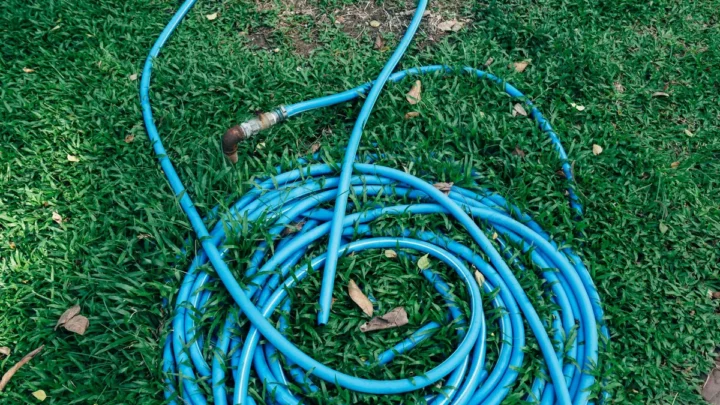
Garden Hose Radius 0.0120 m: Water Flow Explained
If you've landed on a physics problem that opens with "a garden hose has a radius of 0.0120," you're looking at a classic fluid-flow question. The setup looks simple. The numbers are what trip people up.
Most of the confusion comes from one tiny value and what it actually stands for.
That 0.0120 is a radius measured in meters, so the hose opening is 1.20 cm across the middle. Pair it with a flow rate or a nozzle size, and you can solve for the water's speed using the continuity equation. As of 2026, this exact problem still shows up in OpenStax and most intro physics courses.
Let's break down what it's really asking.
What the Problem Is Really Asking (and Why the 0.0120 m Matters)
The stem "a garden hose has a radius of 0.0120" is almost always incomplete on its own. It gives you one measurement. It expects you to bring the rest.
That 0.0120 is the inner radius of the hose in meters. Written properly, it's r = 0.0120 m. Three significant figures, which tells you how precise your final answer should be.
Textbook versions then add one or two more numbers. Usually a volume flow rate, like water leaving at 30 liters per minute. Sometimes a nozzle radius at the end of the hose, often around 0.00300 m.
From there, the question asks one of three things:
- The speed of the water inside the hose
- The speed of the water as it exits a narrower nozzle
- The flow rate, if you're given the speeds instead
Here's the key idea. The radius controls the cross-sectional area. The area controls the speed for a given flow rate.
So that one small number does a lot of heavy lifting. Get it wrong, and every step after it collapses.
The Quick Answer: Speed and Flow in a Garden Hose
A garden hose with a radius of 0.0120 m has a cross-sectional area of about 4.52 × 10⁻⁴ m². Plug in a flow rate to find the water's speed. Use v = Q / A for that.
With a flow of 5.0 × 10⁻⁴ m³/s, the water moves near 1.11 m/s. A narrower nozzle makes it exit much faster.
That's the whole engine of the problem. Area first, then speed. Everything else is just careful bookkeeping with the numbers you're handed.
How the Continuity Equation Works (A₁v₁ = A₂v₂)
The continuity equation says the same amount of water that flows in must flow out. Water can't pile up or vanish inside a hose. So the volume flow rate stays constant from one end to the other.
Written out, it looks like this:
A₁v₁ = A₂v₂
- A₁ is the cross-sectional area at point 1
- v₁ is the water's speed at point 1
- A₂ and v₂ are the area and speed at point 2
Both sides equal the volume flow rate, usually called Q. So you can also write it as Q = A × v. That single relationship solves most garden hose questions.
The logic is conservation of mass, and it holds for any incompressible fluid like water. The U.S. National Institute of Standards and Technology keeps the reference definitions for the SI units you'll use here, which is worth knowing when you check your work.
Notice what the equation tells you. If the area shrinks, the speed has to rise to keep Q the same. Squeeze the opening, and the water speeds up.
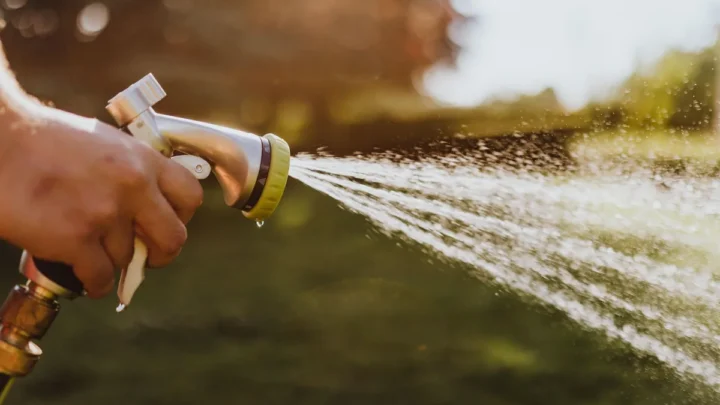
That's the physics behind putting your thumb over the end while watering the garden.
Turning the Radius Into a Cross-Sectional Area
A garden hose has a round opening, so its area is a circle. The formula is A = πr². This is the single step where most people lose marks, so slow down here.

With r = 0.0120 m, the math runs like this:
- r² = (0.0120)² = 0.000144 m²
- A = π × 0.000144
- A ≈ 4.52 × 10⁻⁴ m²
That's your hose area. Keep it handy, because every speed calculation leans on it.
Radius vs. Diameter: The Mistake That Wrecks the Answer
The most common error is using the diameter where the radius belongs. The problem gives you a radius of 0.0120 m. The diameter would be double that, 0.0240 m.
If you accidentally plug the diameter into A = πr², your area jumps by a factor of four. Your speed answer then comes out four times too small. Always confirm which one the problem handed you before you square anything.
Getting Your Units Into SI Before You Plug In
Convert everything to meters, cubic meters, and seconds before you calculate. Mixed units are the second biggest source of wrong answers.
Here's a quick conversion table for the values you'll usually meet:
| Given value | Common form | SI form |
|---|---|---|
| Radius | 1.20 cm | 0.0120 m |
| Flow rate | 30 L/min | 5.0 × 10⁻⁴ m³/s |
| Nozzle radius | 3.00 mm | 0.00300 m |
| Speed | 1.11 m/s | 1.11 m/s |
Do the conversions first, on their own line. It keeps the actual physics clean and easy to check.
Solving the Standard Version Step by Step
Let's work the most common textbook version from start to finish. Water flows through the hose at 30 liters per minute. The hose radius is 0.0120 m.
Find the speed of the water inside the hose, then at a nozzle of radius 0.00300 m.
Step 1: List the Givens and Convert Units
Write down what you have and fix the units first.
- r₁ = 0.0120 m (hose radius)
- r₂ = 0.00300 m (nozzle radius)
- Q = 30 L/min = 0.030 m³ ÷ 60 s = 5.0 × 10⁻⁴ m³/s
Step 2: Calculate the Hose Area with A = πr²
Square the hose radius, then multiply by π.
- A₁ = π(0.0120)² = π × 0.000144
- A₁ ≈ 4.52 × 10⁻⁴ m²
Step 3: Apply Q = Av to Find the Water's Speed
Rearrange Q = A × v to solve for speed. That gives v = Q / A.
- v₁ = (5.0 × 10⁻⁴) ÷ (4.52 × 10⁻⁴)
- v₁ ≈ 1.11 m/s
So the water crawls through the hose at just over one meter per second. That matches what you'd feel filling a watering can for the flower beds.
Step 4: Find the Nozzle Exit Velocity
Now use continuity. The flow rate stays the same, so A₁v₁ = A₂v₂.
First find the nozzle area:
- A₂ = π(0.00300)² ≈ 2.83 × 10⁻⁵ m²
Then solve for v₂:
- v₂ = Q ÷ A₂ = (5.0 × 10⁻⁴) ÷ (2.83 × 10⁻⁵)
- v₂ ≈ 17.7 m/s
The water leaves the nozzle around 16 times faster than it moved in the hose. Same water, same flow rate, much smaller opening. That jump is the whole point of the problem, and the next section explains why the numbers behave that way.
Worked Numbers: r = 0.0120 m in Action
Let's line up the key results so you can see the pattern at a glance. Same water, same flow rate of 5.0 × 10⁻⁴ m³/s, two very different openings.
| Point in system | Radius (m) | Area (m²) | Speed (m/s) |
|---|---|---|---|
| Inside the hose | 0.0120 | 4.52 × 10⁻⁴ | 1.11 |
| At the nozzle | 0.00300 | 2.83 × 10⁻⁵ | 17.7 |
The radius dropped to a quarter of its original size. The area fell to a sixteenth. The speed climbed sixteen times higher.
Those three moves are locked together.
This is the payoff of the whole problem. Once you have the hose area and the flow rate, every other value falls out in one line. No guessing, no extra formulas.
Why a Narrow Nozzle Speeds the Stream (the r² Relationship)
The speed jumps because area depends on the square of the radius. Halve the radius, and the area drops to a quarter. Cut it to a third, and the area drops to a ninth.
Since the flow rate stays fixed, the speed has to swing the other way. Smaller area means faster water. That inverse link is why the r² term matters so much.
Here's the clean version of the rule:
- Area scales with r², so v scales with 1/r²
- Radius down by 2× means speed up by 4×
- Radius down by 4× means speed up by 16×
Our nozzle example proves it. The radius fell from 0.0120 m to 0.00300 m, a factor of four. The speed rose by exactly sixteen.
That's the r² relationship doing its job. It's the same reason a thumb over the end sends water shooting across the yard while you're watering the garden.
When to Reach for Bernoulli's Equation Instead
Use the continuity equation when you only need to link areas and speeds. Reach for Bernoulli's equation when pressure or height enters the picture.
Continuity handles conservation of mass. It answers "how fast does the water move." Bernoulli's equation handles conservation of energy, tying together pressure, speed, and elevation.
You'll want Bernoulli when the problem asks something like:
- The water pressure inside the hose versus at the nozzle
- How high the stream rises when aimed straight up
- The force or pressure needed to push a given flow rate
For the standard "a garden hose has a radius of 0.0120" question, continuity alone is enough. If the problem stays quiet about pressure and height, don't over-complicate it. Save Bernoulli for when those words actually appear.
Common Errors That Cost You the Marks
Most lost points on this problem trace back to a handful of slips. Our review of common student mistakes shows the same ones repeating.
- Using diameter for radius. The problem says radius. Squaring the diameter makes your area four times too big.
- Forgetting to square r. Writing A = πr instead of A = πr² wipes out the whole answer.
- Leaving flow rate in L/min. Convert to m³/s first, or your speed will be off by a factor of tens of thousands.
- Rounding too early. Keep extra digits until the final line, then round to three significant figures to match the 0.0120.
- Swapping subscripts. Match A₁ with v₁ and A₂ with v₂. Mixing them flips your ratio upside down.
One more quiet trap. Students sometimes assume the water speeds up on its own inside the hose. It doesn't.
Speed only changes when the cross-sectional area changes.
How Do You Check If Your Answer Is Reasonable?
Compare it against the flow you'd expect from a real hose. A speed of roughly 1 to 2 m/s inside a standard hose is sensible. A nozzle exit in the range of 10 to 20 m/s also looks right.
If your hose speed comes out at 40 m/s, something broke. Retrace your units and your radius. A quick sanity check catches most calculation errors before they cost you.
Expert Tips for Fluid-Flow Problems
A few habits make continuity problems almost automatic. These come straight from how physics instructors grade the work.
- Write the equation before the numbers. Start with A₁v₁ = A₂v₂ or Q = Av. It keeps your logic visible for partial credit.
- Convert units on a separate line. Never bury a conversion inside a bigger calculation. Isolate it so mistakes stand out.
- Carry units through every step. If the units don't cancel to m/s, your setup is wrong. Units are a free error-checker.
- Solve symbolically first. Rearrange to v = Q/A before plugging in. Cleaner algebra means fewer arithmetic slips.
One last piece of advice. Treat the radius as the most important number on the page. It feeds the area, which feeds every speed you calculate.
Nail that first move, and the rest of the problem tends to solve itself.
Real Scenarios: From Textbook Hose to Real Watering
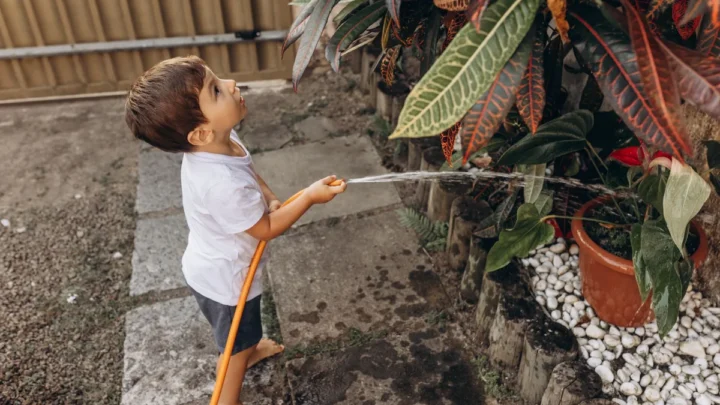
The same math plays out every time you water the yard. A wider hose moves water slowly but in high volume. Pinch the end, and you trade volume for reach.
Say you're soaking a bed of thirsty perennials. The full 0.0120 m opening delivers a gentle, high-flow stream at about 1 m/s. That's ideal for deep watering without blasting the soil.
If you're brightening up a flower bed, that slow soak is what the roots want.
Now switch to a distant border along a fence line. Add a nozzle, and the exit speed jumps toward 18 m/s. That reach lets you water a cozy cottage plot without dragging the hose across every bed.
The trade-off is always the same. Flow rate stays fixed by your tap. You're only choosing how to spend it, wide and slow or narrow and fast.
This intuition helps beyond the garden too. It explains drip lines, sprinkler heads, and even watering container plants indoors. Anywhere water passes through a changing pipe width, continuity is running the show.
If you want more practical setups like screening a dull boundary with planted cover, the same watering logic applies once the beds go in.
For a physics exam, though, keep it clean. Read the given radius, find the area, apply Q = Av. The garden picture is just there to prove the numbers make sense.
You'll find plenty more hands-on guides over on the main resource hub.
Frequently Asked Questions
What does a radius of 0.0120 mean in this problem?
It means the hose opening measures 0.0120 meters from center to edge. That's 1.20 centimeters, or a full diameter of 2.40 centimeters. The value is already in SI units, so you can plug it straight into A = πr² without converting.
Do I need the flow rate to solve it?
Yes, in most versions you need either the flow rate or a second speed. The radius alone only gives you the area. To find the water's speed, pair that area with a flow rate using v = Q/A, or with a known speed using continuity.
Why does the water speed up at the nozzle?
The water speeds up because the nozzle has a smaller cross-sectional area. Flow rate stays constant, so a tighter opening forces higher speed. Since area depends on r², a small drop in radius creates a large jump in exit velocity.
Should I use continuity or Bernoulli's equation?
Use continuity when the question only involves areas and speeds. Switch to Bernoulli's equation when pressure or height appears. For a plain speed calculation from a hose radius and flow rate, continuity is all you need.
How many significant figures should the answer have?
Match the given data, which is three significant figures here. The radius 0.0120 sets that precision. Round only at the very end, so a hose speed lands as 1.11 m/s and a nozzle speed as roughly 17.7 m/s.
The Solved Takeaway You Can Reuse
Every version of this problem runs on three moves. Find the area with A = πr². Link areas and speeds with A₁v₁ = A₂v₂.
Tie speed to flow with Q = Av.
Keep the radius honest, keep units in SI, and round at the end. With r = 0.0120 m, expect a hose speed near 1.11 m/s and a nozzle speed around 17.7 m/s. Those numbers are your quick check for any similar setup.
Lock in that pattern once, and the next fluid-flow question won't slow you down. Read the radius, build the area, follow the water.

Similar Posts