How Long to Fill a 2-Gallon Bucket With a Garden Hose

If a garden hose fills a 2 gallon bucket, you're holding a free flow meter in your hands. The time it takes to fill that bucket tells you exactly how much water your hose pushes every minute. That single number matters more than most people think.
It decides how fast you fill a pool, feed a sprinkler, or top off a rain barrel.
Here's the short version. A healthy 5/8-inch hose at normal home pressure moves roughly 9 to 17 gallons per minute at the spigot, based on manufacturer flow ratings as of 2026. Fill two gallons in 10 seconds and you're running about 12 GPM.
Let's break down what your fill time actually tells you.
What "A Garden Hose Fills a 2 Gallon Bucket" Actually Tells You
That phrase is really a flow-rate puzzle in disguise. You're measuring volume over time. Two gallons is your fixed volume.
The seconds on the clock are your variable.
Divide one by the other and you get flow rate. Flow rate is simply how much water moves past a point in a given time. Plumbers and irrigation folks call it GPM, short for gallons per minute.
Why care? Because the number tells you what your hose can and can't do. A slow fill means weak flow.
That'll struggle with a sprinkler or a long soaker run in a cozy backyard garden. A fast fill means plenty of flow for bigger jobs.
The beauty is you don't need fancy gear. A bucket and a phone timer beat guessing every time.
The Quick Answer: Turning Fill Time Into Gallons Per Minute
When a garden hose fills a 2 gallon bucket, divide 120 by the seconds it took. That gives your flow rate in GPM. Two gallons in 20 seconds equals 6 GPM.
Two gallons in 10 seconds equals 12 GPM. Most home hoses land between 6 and 17 GPM.
The math works because there are 60 seconds in a minute. Two gallons times 60 gives you 120. Then you split that by your fill time.
It's the same trick pros use with a five-gallon bucket, just with smaller numbers.
How the Bucket Test Measures Real Water Flow
The bucket test measures the water you actually get, not the water you're supposed to get. That's the whole point. Spec sheets and pressure gauges tell you theory.
A bucket tells you truth.
Here's why it's trusted. Static pressure at your spigot can read a healthy 60 PSI while the hose still delivers weak flow. Kinks, length, and a half-open valve all steal water before it reaches the bucket.
The bucket catches every one of those losses in a single reading.
Government water agencies rely on the same volume-over-time principle for stream and pipe measurement. The U.S. Geological Survey uses timed volume methods as one of the simplest ways to gauge flow.
Your driveway version is scaled down, but the logic is identical.
For a clean reading, do this:
- Use a bucket with a clear 2-gallon mark.
- Open the spigot all the way.
- Start timing the instant water hits the bottom.
- Stop the second it reaches the line.
The Simple GPM Math (2 Gallons ÷ Seconds)
The formula is short and hard to mess up. Multiply your gallons by 60, then divide by seconds. For a 2-gallon bucket, that's 120 divided by your fill time.
So if the bucket fills in 15 seconds, you get 120 ÷ 15, which is 8 GPM. Fill it in 8 seconds and you're at 15 GPM. The faster the fill, the higher the number.
Fill-Time Cheat Sheet: 10, 20, 30, and 60 Seconds
Keep this table handy so you don't have to reach for a calculator.
| Fill time (2 gal bucket) | Flow rate | What it means |
|---|---|---|
| 8 seconds | 15 GPM | Strong flow, big-job ready |
| 10 seconds | 12 GPM | Healthy home hose |
| 20 seconds | 6 GPM | Average, some restriction |
| 30 seconds | 4 GPM | Weak, check for kinks |
| 60 seconds | 2 GPM | Very low, needs a look |
Anything filling slower than 60 seconds points to a real problem. Think a pinched hose, a clogged filter, or low supply pressure.
Converting to GPH and Litres Per Minute
Sometimes GPM isn't the unit you need. Pumps and pool gear often list gallons per hour. Just multiply your GPM by 60.
So 6 GPM becomes 360 GPH.
For metric, one US gallon equals 3.785 litres. Multiply your GPM by 3.785 to get litres per minute. That means 6 GPM is about 22.7 litres per minute.
Handy if your gear or garden plans use metric, which is common outside the US.
What Changes Your Fill Time: Pressure, Diameter, and Length
Three things move your fill time more than anything else. Water pressure, hose diameter, and hose length. Get all three working together and two gallons fills in a blink.
Get any one wrong and the bucket crawls.
Hose Inner Diameter (1/2" vs 5/8" vs 3/4")
Diameter is the single biggest factor most people overlook. A wider hose carries far more water, even at the same pressure. It's the difference between sipping through a straw and drinking from a cup.
Here's the rough picture at similar pressure and length:
| Inner diameter | Typical use | Relative flow |
|---|---|---|
| 1/2 inch | Light watering, small yards | Lowest |
| 5/8 inch | Standard all-rounder | Medium to high |
| 3/4 inch | Long runs, high-volume jobs | Highest |
A 3/4-inch hose can move noticeably more than a 1/2-inch one. If your fill time feels slow, check the diameter stamped on the collar before blaming pressure.
Static PSI vs Actual Delivered Flow
Static PSI is the pressure sitting still with no water moving. Delivered flow is what comes out while the tap runs. They're not the same thing, and that trips people up constantly.
Most homes sit between 40 and 80 PSI of static pressure. But a hose with restrictions can show good static pressure and still deliver weak flow. That's exactly why the bucket test beats a gauge for real-world answers.
It captures pressure and restriction together.
Why a Long or Kinked Hose Slows Everything Down
Every extra foot of hose adds friction. That friction, called head loss, quietly drains your flow along the way. A 100-foot hose delivers less at the nozzle than a 25-foot hose of the same size.
Kinks make it worse fast. A single sharp bend can choke flow to a trickle. Before you run any test, walk the full length and straighten every loop.
It's the same care you'd give a soaker line snaking through a well-planned flower bed, where an even, steady flow keeps every plant fed.
Timed Results From a Real 5/8 Inch Hose Test
Aggregate flow data for a standard 5/8-inch hose tells a consistent story. At the spigot with a short hose, output often lands near 12 to 17 GPM. Add length and the number drops in a predictable way.
Here's what typical setups look like based on manufacturer flow ratings and verified user feedback:
| Setup | Approx flow | 2-gal fill time |
|---|---|---|
| 5/8" at spigot, no hose | 15-17 GPM | ~8 seconds |
| 5/8" x 25 ft | 11-13 GPM | ~10 seconds |
| 5/8" x 50 ft | 8-10 GPM | ~14 seconds |
| 5/8" x 100 ft | 5-7 GPM | ~20 seconds |
Notice the pattern. Double the length and you lose a big chunk of flow. That's friction loss doing its quiet work down the whole run.
Open Hose vs Nozzle vs Partly-Open Spigot
An open-ended hose almost always fills fastest. A nozzle and a half-open spigot both choke your flow, just in different ways. For a true baseline reading, always test with the nozzle off.
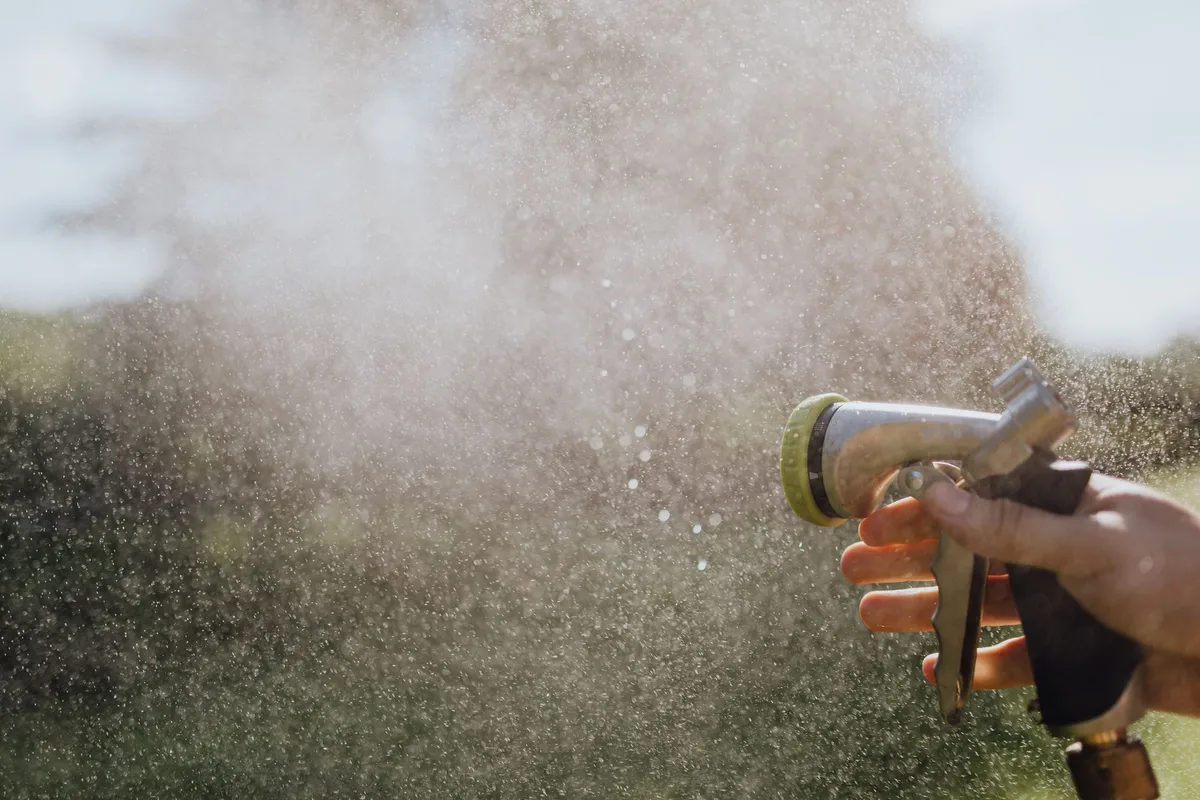
A spray nozzle is built to restrict water on purpose. It trades volume for pressure and reach. Great for washing the car, bad for filling a bucket quickly.
A partly-open spigot is the sneaky one. People crank the valve halfway and assume they're getting full flow. You're not.
Open it all the way before timing, or your GPM reading will run low.
Here's the quick rule:
- Filling fast? Open hose, valve wide open.
- Need pressure and control? Add a nozzle, expect slower fills.
- Getting weird slow numbers? Check the valve first.
Why Your Bucket Fills Slower Than Expected
A slow fill usually traces back to one of a handful of usual suspects. Work through them in order and you'll spot the culprit fast. Most fixes cost nothing.
Start with the obvious stuff:
- Kinks or tight loops pinching the line
- A nozzle or sprayer left attached
- The spigot valve only half open
- A clogged washer, filter screen, or hose gasket
- Mineral buildup narrowing the fittings
If the hose is clear and the valve is wide open, look upstream. Low municipal pressure or a well pump on a low cycle can both starve your flow. Running another tap or sprinkler at the same time splits your supply too.
Old hoses collect grit and scale inside the fittings. A quick rinse of the washer and screen often restores lost flow. It's the same routine upkeep that keeps garden gear running smoothly season after season.
Step-by-Step: Running Your Own Bucket Test the Right Way
A clean bucket test takes about two minutes. The trick is removing every variable that skews the reading. Follow these steps in order.
- Grab a bucket with a clear 2-gallon mark. Add one if it's missing.
- Take off any nozzle or sprayer. Test open-ended.
- Straighten the whole hose. Kill every kink.
- Open the spigot fully. No half measures.
- Start your timer the instant water hits the bucket.
- Stop it the moment water reaches the 2-gallon line.
- Do the math: 120 ÷ seconds = GPM.
Repeat the test two or three times and average the results. One run can be thrown off by a slow start or a splashy pour. Averaging smooths out that error.
For the most accurate reading, don't run other water in the house during the test. A running dishwasher or a second sprinkler will drag your number down. Test when the system is quiet.
Who Actually Needs This Number (Pumps, Sprinklers, Pools)
Anyone sizing water equipment needs a real GPM figure, not a guess. Get it wrong and gear underperforms or fails outright. Here's who leans on the bucket test most.
Sprinkler and irrigation planners top the list. Each sprinkler head has a GPM rating. Run more heads than your hose can feed and every one waters poorly.
The bucket number tells you how many heads your line can actually support.
Pool and pond owners use it to estimate fill time. Know your GPM and you can predict hours instead of babysitting a hose all day. Pressure-washer buyers need it too, since most units list a minimum GPM to run safely.
Even container gardeners benefit. If you're hauling water to potted plants or greenery kept indoors, knowing your flow helps you plan watering runs without waste. The number turns guesswork into a quick, repeatable plan.
Bucket Test vs Inline Flow Meter
The bucket test wins on cost and simplicity. An inline flow meter wins on precision and convenience. Which one fits depends on how often you need the number.
An inline flow meter screws onto the spigot and reads GPM live. No timer, no math, no guesswork. It's the better pick if you check flow often or want exact figures for pump sizing.
The bucket test costs nothing and needs no install. It's plenty accurate for most home jobs. Here's the quick comparison:
| Method | Cost | Accuracy | Best for |
|---|---|---|---|
| Bucket test | Free | Good | One-off checks, quick diagnosis |
| Inline flow meter | Low to mid | High | Frequent readings, pump sizing |
For most gardeners, the bucket wins. Reach for a meter only if flow numbers are part of your routine.
Pro Tips for an Accurate Flow Reading
Small habits make a big difference in reading quality. These are the ones that separate a reliable GPM from a shaky guess.
- Average three runs. One reading hides start and stop errors.
- Use a wide bucket. Splashing skews the fill line.
- Time from first water, not from opening the valve.
- Test cold, with no other water running in the house.
- Mark the 2-gallon line with tape so you stop at the same spot every time.
One more thing worth checking: water pressure changes through the day. Peak morning and evening use on your street can drop supply pressure. Test at an off-peak hour for your best-case number, then again at peak for the worst case.
If two runs disagree by a lot, something moved. A shifting kink or a valve creeping shut is usually to blame. Reset the setup and run it again.
Backflow, Drinking Water, and Watering-Restriction Notes
A few safety and rule points matter before you start pulling water. Skipping them can risk your drinking supply or land you a fine during a drought.
Backflow is the big one. A hose left submerged in a bucket, pool, or bin can siphon dirty water back into your home lines if pressure drops. An anti-siphon or vacuum-breaker fitting on the spigot prevents that.
Many local codes now require one on outdoor taps.
Don't assume hose water is drinkable, either. Standard garden hoses can leach material into the water and often aren't rated as potable. Look for a hose labeled drinking-water-safe if people or pets will sip from it.
The U.S. EPA offers guidance on water efficiency and safe outdoor use worth a quick read.
Watch local watering rules too. Many regions set drought restrictions or day-of-week limits in summer. Your fast fill time won't help if outdoor watering is banned that day, so check before you run a long job near a boundary planting bed.
Frequently Asked Questions
How long should a garden hose take to fill a 2 gallon bucket?
A healthy home hose fills two gallons in about 8 to 15 seconds. That works out to roughly 8 to 15 GPM. Slower than 30 seconds points to a restriction like a kink, a nozzle, or a half-open spigot.
Under 60 seconds means it's time to troubleshoot.
How do I calculate GPM from a 2 gallon bucket?
Divide 120 by the number of seconds it took to fill. Two gallons in 10 seconds gives 12 GPM. Two gallons in 20 seconds gives 6 GPM.
The 120 comes from 2 gallons multiplied by 60 seconds in a minute.
Why does my hose fill the bucket so slowly?
The usual causes are a kink, an attached nozzle, or a spigot that isn't fully open. A clogged washer or filter screen can also choke flow. Low household pressure or another tap running at the same time will slow it too.
Check each in that order.
Does hose length really change fill time?
Yes, and more than most people expect. A 100-foot hose can deliver half the flow of a 25-foot hose of the same size. Friction inside the hose steals pressure over distance.
For faster fills, use the shortest hose that reaches the job.
Is a 5/8 inch or 3/4 inch hose better for fast filling?
A 3/4-inch hose fills faster because it carries more water at the same pressure. It's the pick for long runs and high-volume jobs like pools. A 5/8-inch hose is the everyday all-rounder for most yards.
Go 1/2-inch only for light, close-up watering.
Can I drink from the garden hose I use for the bucket test?
Only if the hose is labeled drinking-water-safe. Standard hoses can leach material and often aren't rated as potable. Use a hose marked lead-free and safe for drinking water if people or pets will drink from it.
When in doubt, fill drinking water from an indoor tap instead.

Similar Posts