Why Are My Cucumber Leaves Yellow With Spots? Causes & Fixes
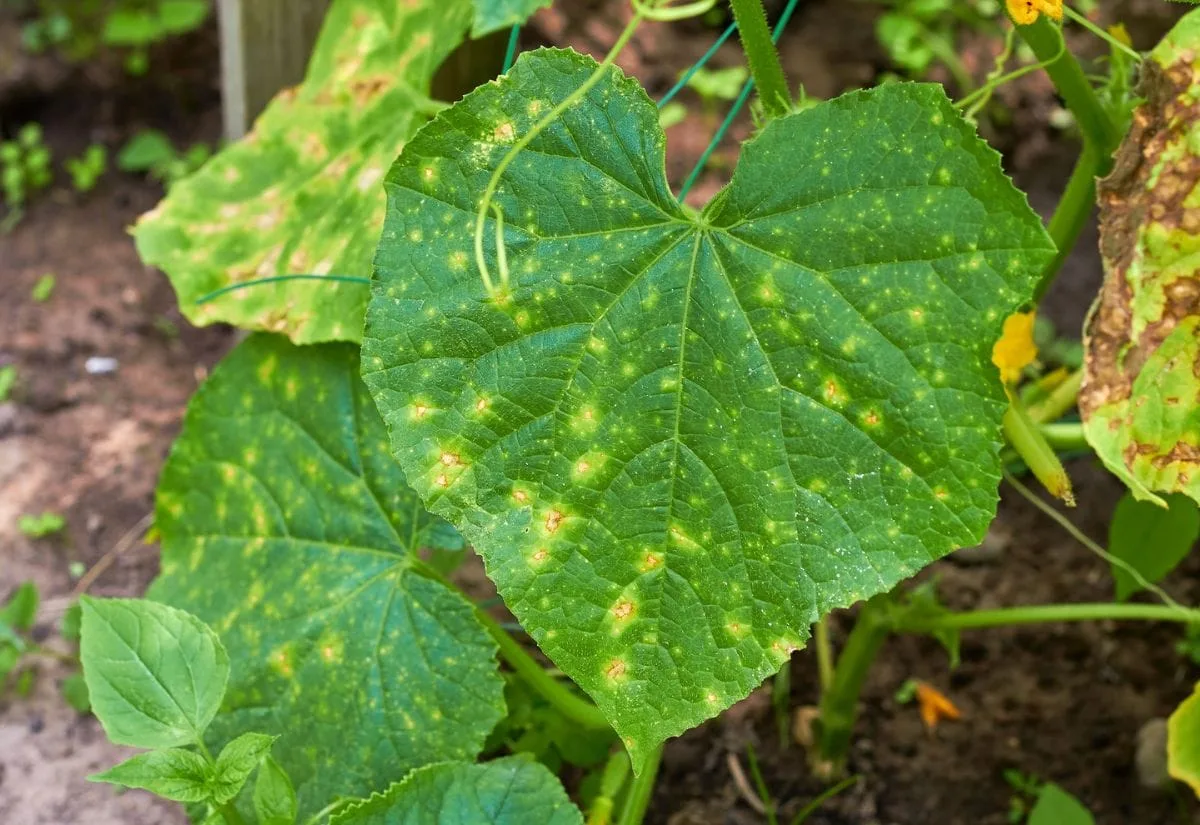
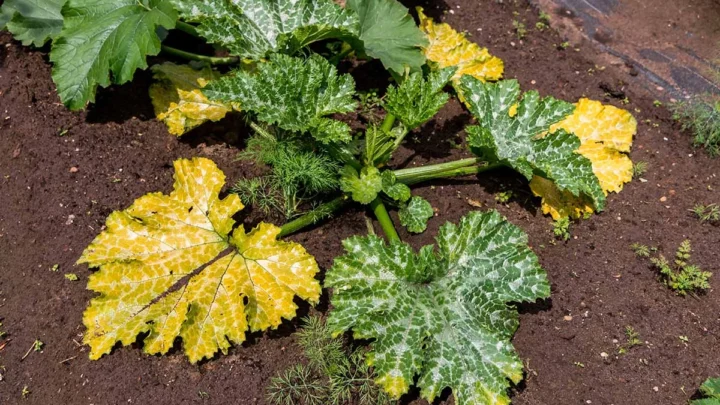
Yellow spots on cucumber leaves rarely mean one thing. Why are cucumber leaves yellow with spots? At least eight different problems can look similar at first glance, from downy mildew and angular leaf spot to spider mite feeding and nitrogen deficiency.
The correct diagnosis lives in the details: spot shape, whether veins bound the lesions, and what you see on the leaf's underside in the morning.
Getting the ID right matters more than most gardeners realize. Downy mildew alone can wipe out a cucumber crop within 5 to 7 days once it takes hold, according to research reported by Cornell University's College of Agriculture and Life Sciences. This guide walks you through what each pattern looks like, side by side, so you can act before the vine is lost.
Quick Answer
Cucumber leaves turn yellow with spots for three broad reasons. Fungal diseases like downy mildew form angular yellow patches. Bacterial angular leaf spot creates vein-bounded water-soaked lesions.
Pests such as spider mites leave fine yellow stippling. Nutrient shortages cause broader yellowing without sharp spots. Spot shape and location reveal the true cause.
Why Cucumber Leaves Turn Yellow With Spots (What You're Actually Looking At)
Yellow spotted cucumber leaves signal one of four things. A pathogen (fungal, bacterial, or viral). A pest chewing or sucking on the foliage.
A nutrient the roots can't reach. Or an environmental stress like waterlogged soil.
Each cause writes a different signature on the leaf. Downy mildew paints angular yellow blocks. Anthracnose stamps concentric rings.
Mosaic viruses splash mottled patterns across the whole surface. Spider mites leave a fine pale dust of pinpricks.
That's why the fix depends entirely on the ID. A copper spray does nothing to a mosaic virus. Fertilizer won't stop bacterial spread.
Get the diagnosis wrong and you burn time while the vine dies.
Read the Spots First: Color, Shape, and Where They Show Up
Before you spray anything, spend two minutes with the leaf. Turn it over. Check young growth and old growth.
Look for the three visual anchors below, because they narrow the field fast.
Spot Shape
- Angular blocks bounded by veins point to downy mildew or angular leaf spot
- Circular with concentric rings point to anthracnose or alternaria
- Fine pinpoint stippling points to spider mites
- Mottled irregular blotches point to mosaic virus
Leaf Underside
- Fuzzy purple-gray growth means downy mildew sporulation
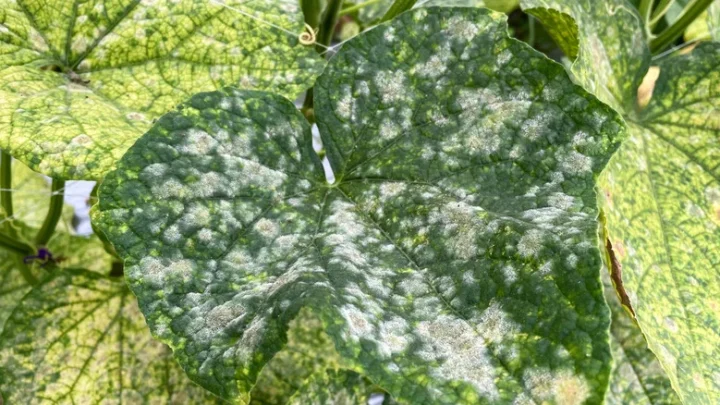
- White powder means powdery mildew (also visible on top)
- Milky ooze from water-soaked spots means bacterial angular leaf spot
- Clean underside with speckled top means mite damage or nutrient issue
Location on the Plant
Older lower leaves affected first often points to nitrogen or magnesium shortage. New top growth affected first suggests iron shortage or viral infection. Widespread damage on middle leaves usually means a spreading fungal or bacterial disease.
Downy Mildew: Angular Yellow Patches With Fuzzy Purple Undersides
Downy mildew (Pseudoperonospora cubensis) is the number one killer of cucumber vines in humid regions. The tell is unmistakable once you know it. Yellow patches on the upper leaf stop cold at the veins, forming a mosaic of small angular blocks.
Flip the leaf on a humid morning and you'll see grayish-purple fuzz sitting in each patch.
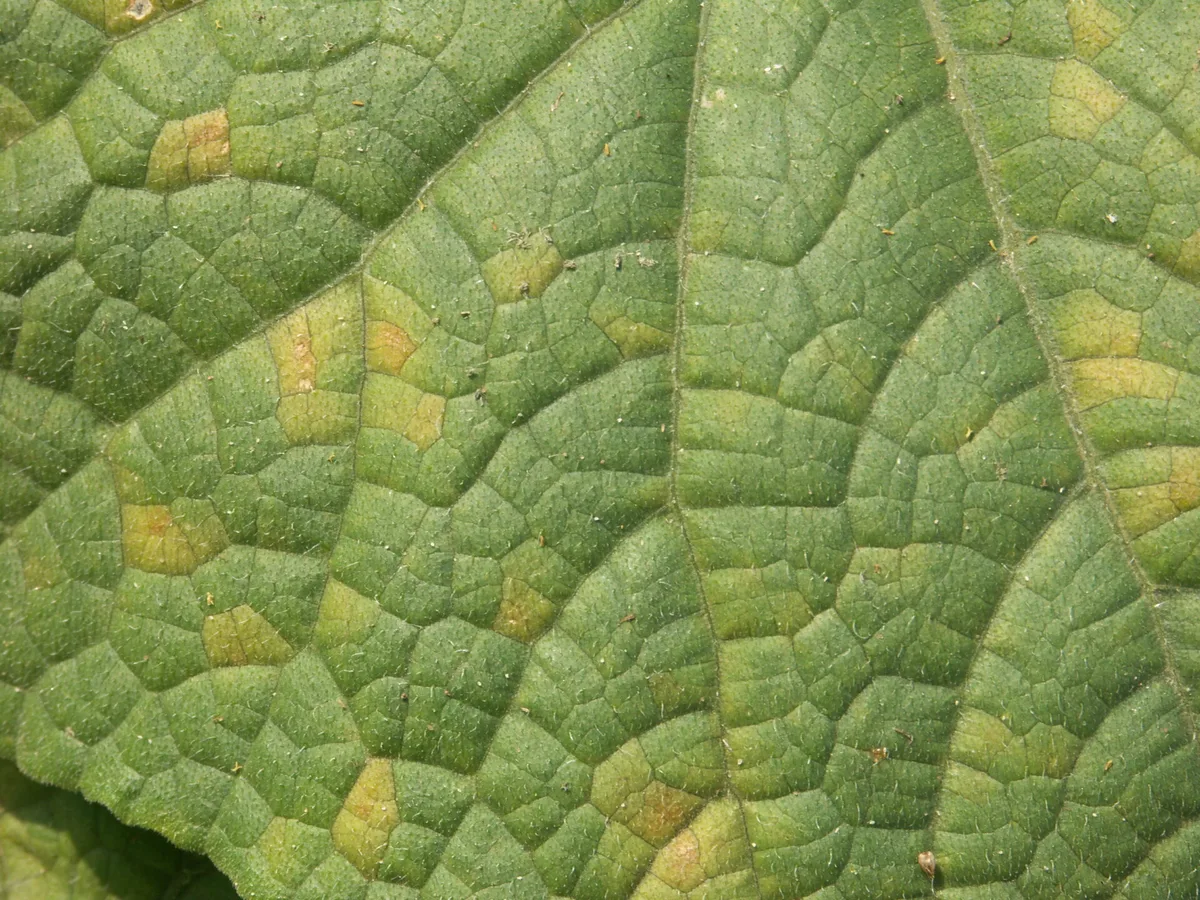
The pathogen isn't a true fungus. It's a water mold, which is why plenty of standard fungicides fall short against it. It thrives between 59 and 68°F with at least six hours of leaf wetness.
Spores travel on wind currents, sometimes hundreds of miles in a single storm system. As of 2026, growers in the eastern US track live outbreaks through the Cucurbit Downy Mildew ipmPIPE forecast.
Speed matters. A visible outbreak in the morning can collapse a vine within a week if humidity holds. Remove infected leaves right away.
Switch off overhead watering. Apply a labeled fungicide with activity against oomycetes, such as one containing mefenoxam, fosetyl-Al, or oxathiapiprolin, and follow the pre-harvest interval.
Angular Leaf Spot: Vein-Bounded Water-Soaked Lesions That Fall Out
Angular leaf spot looks a lot like downy mildew until you get close. Both make angular yellow patches bounded by veins. The difference lives on the underside of the leaf.
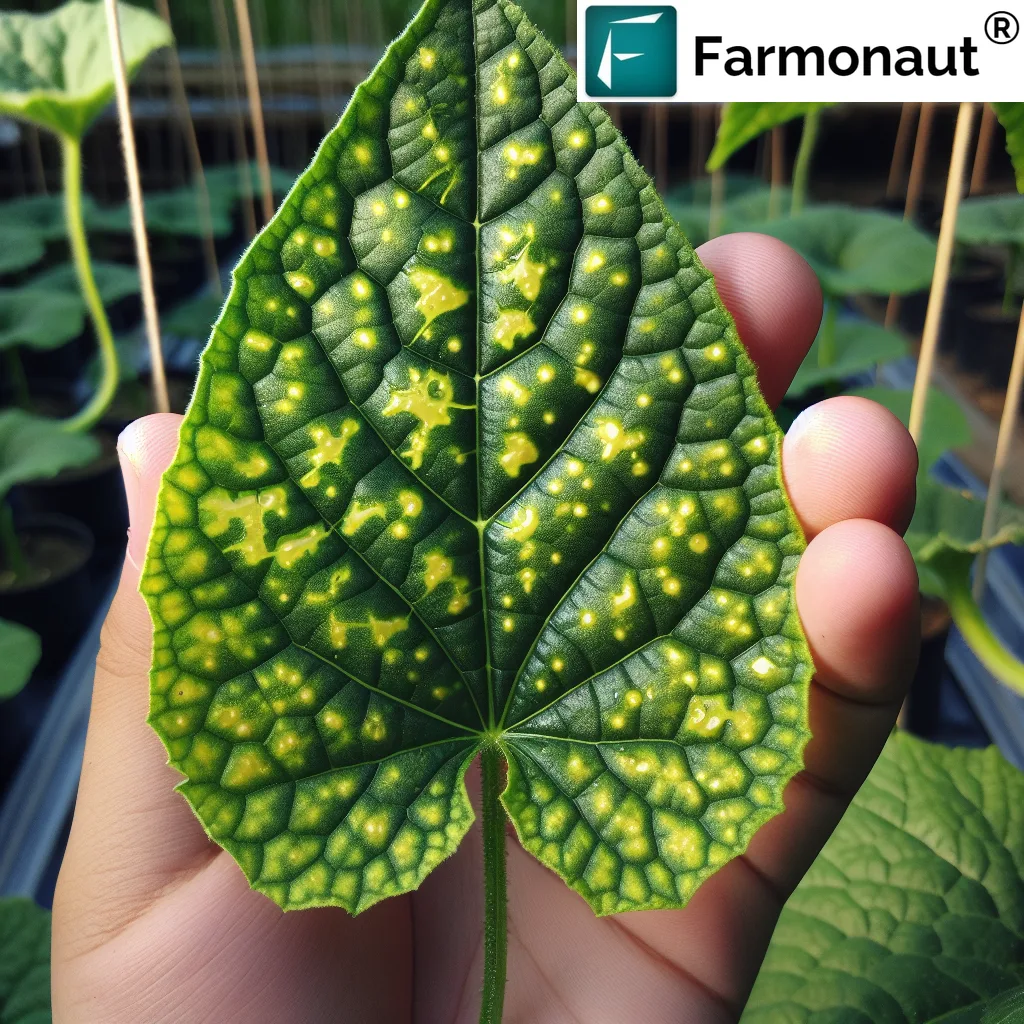
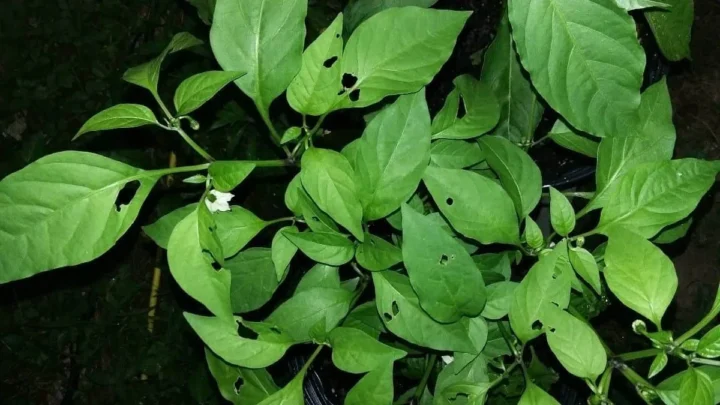
Angular leaf spot is bacterial, caused by Pseudomonas syringae pv. lachrymans. Instead of purple fuzz, you'll spot small water-soaked areas that ooze a milky bacterial slime in wet weather. As the lesions age, the tissue dies and drops out, leaving a classic shot-hole look.
Fruit picks up sunken lesions that leak.
The bacteria spread through splashing water, tools, and worker hands. Once free water sits on a leaf, spread is quick. Common triggers include overhead irrigation, working in wet plants after rain, and a tight canopy that never dries.
Treatment is mostly cultural. Copper-based bactericides labeled for cucurbits slow spread but won't cure infected tissue. Stop overhead watering right away.
Prune to open airflow. Rotate off cucurbits for two to three years, and buy certified disease-free seed next spring, because the bacterium is seed-borne.
Anthracnose and Alternaria: Concentric Rings and Target-Like Blotches
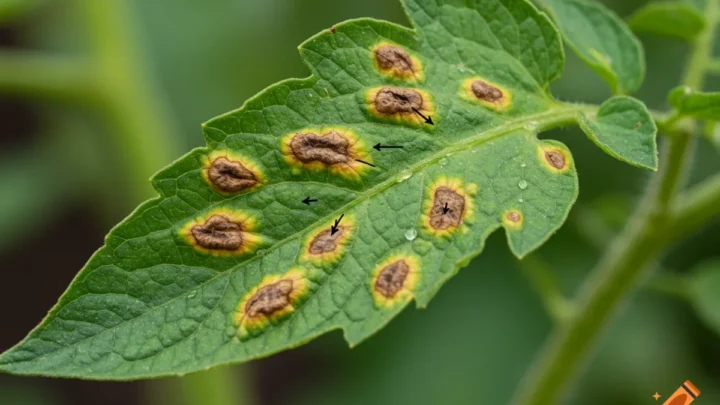
Anthracnose (Colletotrichum orbiculare) and alternaria leaf blight (Alternaria cucumerina) both build round lesions with darker rings inside them. They're the archer's-target spots on the leaf, and they're easy to confuse without a close look.
Anthracnose starts as small water-soaked flecks that expand into tan or brown circles up to half an inch across. In wet weather you may see pinkish spore masses at the lesion centers. Fruit gets sunken pink-tinged spots that ruin storage life.
Alternaria goes for older leaves first. Circular brown spots with clear concentric rings, often ringed by a yellow halo, form on the lower canopy and creep upward. It loves warm humid nights above 70°F.
Both spread through spores in splashing water and infected debris. Both survive winter on last year's plant residue. Key moves for control:
- Rip out lower infected leaves and bag them, never compost them
- Stake or trellis vines to lift foliage off wet soil
- Rotate away from cucurbits for at least two years
- Apply a broad-spectrum labeled fungicide such as chlorothalonil or mancozeb at first signs, respecting the pre-harvest interval
Powdery Mildew: White Coating That Turns Leaves Yellow From Above
Powdery mildew starts on the top of the leaf, not the bottom. You'll see round white powdery patches that look dusted on with flour. Left alone, those patches merge and cover the whole surface.
The tissue underneath yellows, dries, and curls at the edges.
The culprits are two related fungi (Podosphaera xanthii and Erysiphe cichoracearum). Both love warm days between 68 and 80°F, high humidity, and dry leaves. It's the classic late-summer disease of cucumber patches.
Older lower leaves catch it first. Once the canopy is heavily coated, photosynthesis drops fast. Fruit stops sizing and can develop a bitter taste from stressed vines.
Control moves that work:
- Prune away the most heavily coated leaves the moment you spot them
- Spray potassium bicarbonate or a labeled sulfur fungicide at first symptoms
- Rotate to neem oil or a Bacillus subtilis biofungicide for organic patches
- Plant resistant varieties next season (many modern hybrids carry PM resistance)
Once powdery mildew covers 20% of leaf area, yield loss climbs quickly, so timing beats product choice.
Mosaic Viruses: Mottled Yellow, Curled, and Distorted Growth
Mosaic viruses don't make neat spots. They paint the leaf in an uneven patchwork of light green, yellow, and dark green blotches. New growth comes in wrinkled, curled, or shrunken.
Fruit is often warty, misshapen, or blotchy.
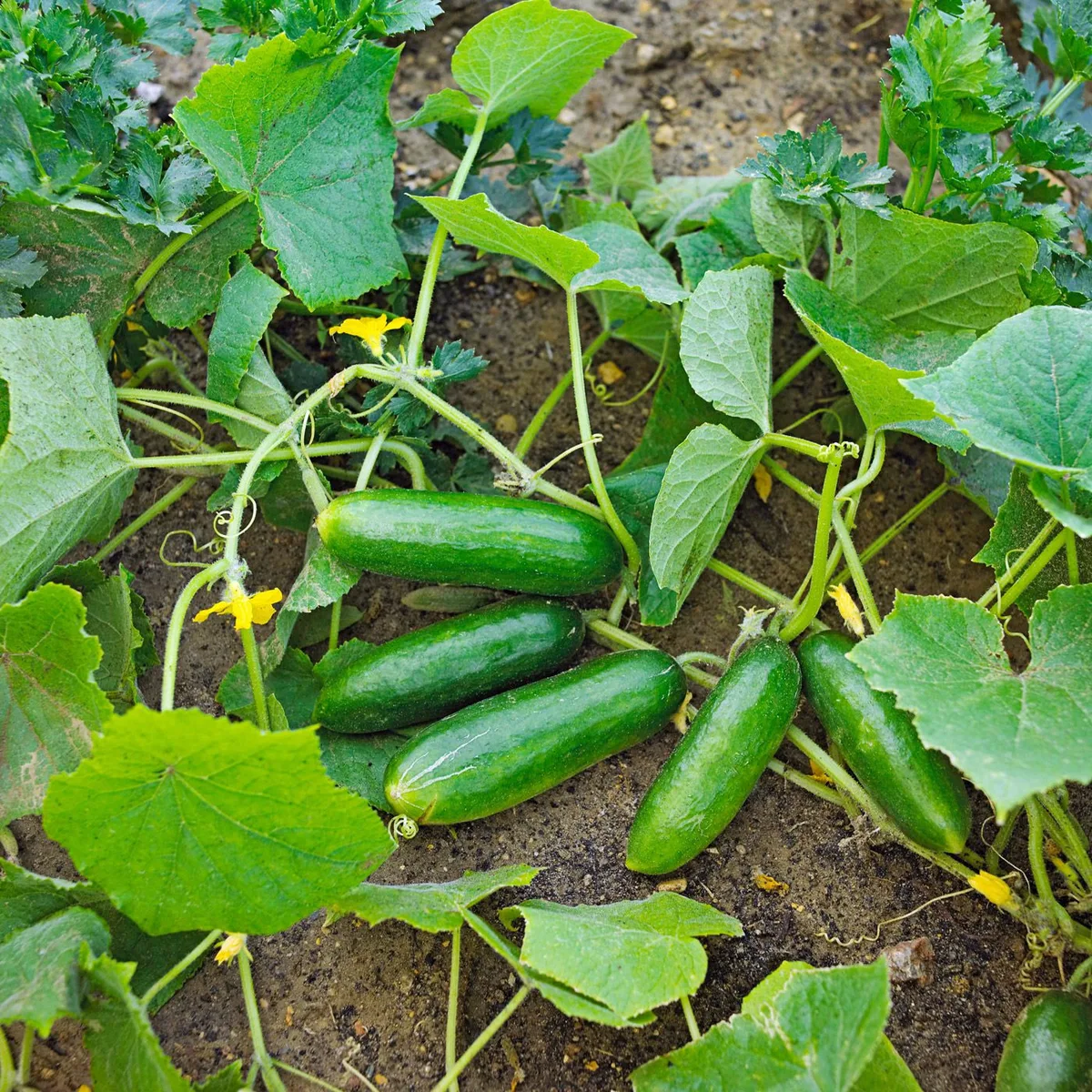
The main viruses hitting cucurbits are Cucumber mosaic virus (CMV), Watermelon mosaic virus (WMV), and Squash mosaic virus (SqMV). Aphids move CMV and WMV between plants in seconds. Cucumber beetles carry SqMV.
There's no cure. Once a plant is symptomatic, it stays infected for life and acts as a reservoir for every other cucurbit nearby.
What to do the moment you're sure:
- Pull the infected plant, roots and all, and bag it
- Wash tools and hands before touching another cucumber
- Control aphids with insecticidal soap or a reflective mulch
- Cover next spring's seedlings with floating row cover until flowering
- Buy virus-tested seed and plant resistant hybrids where available
Spider Mites and Cucumber Beetles: Pest-Driven Yellow Stippling
Not every yellow spot is a disease. Two pests fake the look convincingly.
Spider mites (Tetranychus urticae) live on the leaf underside and pierce individual cells to feed. The result is a fine yellow stippling on the upper surface, almost like someone tapped the leaf with a yellow-tipped pen. Heavy feeding produces bronzing and fine webbing at leaf joints.
They explode in hot, dry weather above 80°F.
Cucumber beetles chew ragged holes and skeletonized patches. Around those wounds, the leaf yellows as the tissue dies back. The bigger problem: striped and spotted cucumber beetles carry bacterial wilt (Erwinia tracheiphila) and squash mosaic virus, so beetle damage often runs alongside sudden vine collapse.
Quick reads for either pest:
- Flip leaves and look for tiny moving dots or fine webbing (mites)
- Check flowers at dawn for feeding beetles
- Look for chewed leaf margins vs pinprick stippling
- Watch for whole vines wilting overnight (bacterial wilt signal)
Blast mites off with a hard water spray for three days running, then follow with insecticidal soap. For beetles, use yellow sticky traps, kaolin clay, or a labeled pyrethrin, and cover seedlings with row cover until flowers open.
Nutrient Deficiency vs Disease: Nitrogen, Magnesium, and Iron Clues
Nutrient issues cause yellowing without the sharp defined spots that pathogens make. Early stages can fool you, so the pattern of yellowing is the key.
| Nutrient | Where it shows first | What you see |
|---|---|---|
| Nitrogen | Older lower leaves | Uniform pale green, then yellow across the whole leaf |
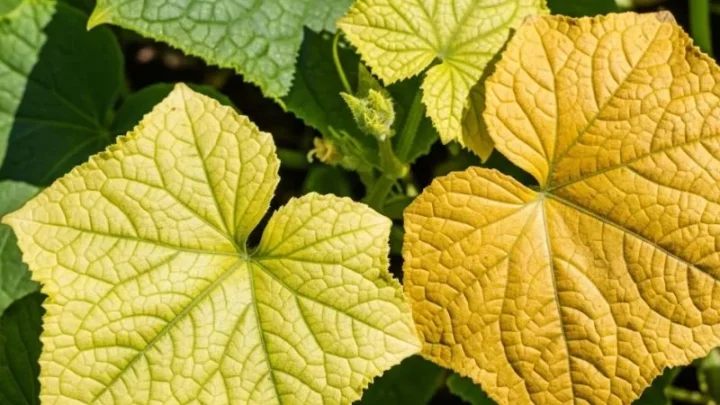
| Magnesium | Older lower leaves | Yellow between the veins, veins stay green |
| Iron | New top growth | Yellow between veins on youngest leaves, veins stay green |
| Potassium | Older leaves | Yellowing plus browning along leaf margins |
| Manganese | New growth | Interveinal yellowing with small dead spots |
Cold, wet soil below 60°F blocks nitrogen and magnesium uptake even when the nutrients are present. A soil pH outside 6.0 to 6.8 locks up iron and manganese. A pH test costs almost nothing and often solves the problem faster than a spray.
Fix it in this order. Test soil pH first. Correct with lime or sulfur if needed.
Foliar feed a balanced liquid fertilizer for a quick boost while roots recover. Side dress with compost or a slow-release organic fertilizer for lasting supply.
Watering, Airflow, and Soil Conditions Behind Most Outbreaks
Most cucumber leaf spots don't start with the pathogen. They start with the conditions that let the pathogen win. Fix these and half your disease problems vanish.
Free water on the leaf triggers downy mildew, angular leaf spot, anthracnose, and alternaria. Every one of them needs the leaf wet for hours to infect. Overhead sprinklers at dusk are the fastest way to invite trouble.
Set watering rules that actually work:
- Water at the base with drip or a soaker hose, never overhead
- Water early morning so any splash dries within an hour
- Keep soil evenly moist, not soaked (waterlogged roots yellow too)
- Mulch with straw or wood chips to stop soil splash carrying spores upward
Airflow is the second big lever. Cucumbers on the ground trap humidity in the canopy. Trellised vines dry within an hour of dew.
Space plants 12 to 18 inches on a trellis, or 36 to 60 inches between rows on the ground.
Soil health closes the loop. A pH between 6.0 and 6.8, steady compost inputs, and a two- to three-year rotation off cucurbits keeps soil-borne inoculum from building up year after year.
Side-by-Side Visual Reference Chart for Cucumber Leaf Symptoms
Save this to your phone. When you're standing in the patch with a suspicious leaf, you want the answer in ten seconds.
| Symptom Look | Most Likely Cause | Underside Check | First Move |
|---|---|---|---|
| Angular yellow patches, vein-bounded | Downy mildew | Purple-gray fuzz in wet weather | Prune, drip water, oomycete fungicide |
| Angular yellow patches, vein-bounded | Angular leaf spot (bacterial) | Milky ooze, later shot holes | Copper spray, stop overhead water |
| White powdery patches on top | Powdery mildew | Clean or lightly dusted | Potassium bicarbonate or sulfur |
| Round tan spots with concentric rings | Anthracnose or alternaria | Pinkish spore mass (anthracnose) | Chlorothalonil, remove lower leaves |
| Mottled yellow, curled new growth | Mosaic virus | Clean | Pull plant, control aphids |
| Fine yellow pinpoint stippling | Spider mites | Tiny moving dots, fine webbing | Water blast, insecticidal soap |
| Uniform yellow, oldest leaves first | Nitrogen deficiency | Clean | Side-dress nitrogen, check pH |
| Interveinal yellow, newest leaves | Iron deficiency | Clean | Correct pH, foliar iron chelate |
Common Visual Mistakes When Diagnosing Yellow Spotted Leaves
Even experienced growers get burned by look-alikes. Watch for these traps.
Confusing downy mildew with angular leaf spot is the classic one. Both make vein-bounded angular yellow patches on top. If you don't flip the leaf on a humid morning, you can't tell them apart.
Copper won't touch downy mildew, and an oomycete fungicide won't cure a bacterial infection.
Reading nutrient deficiency as disease is the second big miss. If yellowing is uniform, the leaf tissue is intact, and there are no discrete spots or fuzz, it's almost never a pathogen. Reach for a soil test before a spray bottle.
Assuming powdery mildew is a top-of-leaf problem only. Some strains sporulate on the underside first. Always check both sides before you conclude nothing is wrong.
Missing early spider mite damage. The stippling looks like light nutrient chlorosis until you notice the moving dots underneath. A cheap 10x jeweler's loupe pays for itself here.
Treatment Match-Up: Cultural, Organic, and Chemical Options by Cause
The right treatment depends entirely on what you've got. Here's the shortlist by cause.
| Cause | Cultural Fix | Organic Option | Conventional Option |
|---|---|---|---|
| Downy mildew | Drip water, prune, rotate | Copper, Bacillus amyloliquefaciens | Mefenoxam, oxathiapiprolin |
| Angular leaf spot | Stop overhead water, sanitize | Copper hydroxide | Copper plus mancozeb |
| Powdery mildew | Spacing, airflow, resistant seed | Potassium bicarbonate, sulfur, neem | Myclobutanil, azoxystrobin |
| Anthracnose / alternaria | Trellis, remove debris | Copper, biofungicide | Chlorothalonil, mancozeb |
| Mosaic virus | Rogue plant, control vectors | Reflective mulch, row cover | None (no cure) |
| Spider mites | Water blast, humidity boost | Insecticidal soap, neem | Bifenazate, abamectin |
| Nutrient deficiency | Soil test, pH correction | Compost, fish emulsion | Balanced NPK, chelated iron |
Always read the label. Respect the pre-harvest interval and the pollinator warnings.
Prevention Playbook for Next Season's Cucumber Patch
Most yellow spot problems start in bed prep, not in July. Set next year up right.
Start with clean seed and clean ground. Buy certified disease-free seed from a reputable supplier. Rip out and destroy all cucurbit debris in fall, because both fungi and bacteria overwinter on residue.
Design the patch for airflow. Trellis your vines vertically. Space plants at 12 to 18 inches on the trellis.
Site the patch where morning sun hits early so dew burns off fast.
Build a routine that works before problems show:
- Water at the base, in the morning only, aiming for 1 to 1.5 inches per week
- Mulch heavily with straw once soil warms to 65°F
- Scout twice a week, checking leaf undersides
- Rotate cucurbits on a 2- to 3-year cycle
- Keep aphid and cucumber beetle populations low from day one
Resistant Cucumber Varieties Worth Planting
Resistance won't make plants bulletproof, but it buys you time. Modern breeding has produced hybrids that shrug off common cucurbit diseases.
For downy mildew, look for cultivars bred with resistance genes from Asian breeding lines. Cornell's 'DMR-401' pickling cucumber and 'Bristol' slicer are two well-documented options.
For powdery mildew, most quality hybrids now carry PM resistance as standard. Check seed catalogs for the "PM" tag next to the variety name.
For mosaic viruses, choose cultivars labeled CMV, WMV, or ZYMV resistant. 'Citadel', 'Diva', and many current commercial slicers combine two or three virus resistances in one line.
Mix and match to your local pressure. In humid eastern US patches, downy mildew resistance is non-negotiable. In drier climates, focus on powdery mildew and virus tolerance instead.
Frequently Asked Questions
Can cucumber plants recover from yellow spotted leaves?
Yes, if you catch the cause early. Nutrient issues and mild pest damage bounce back within one to two weeks. Bacterial and fungal infections stop spreading once conditions change, but existing spots stay.
Viral infections never recover.
Should I remove yellow spotted cucumber leaves?
Remove them if the spots come from disease or heavy pest damage. Bag and trash them, never compost. Leave leaves alone if the yellowing is nutrient-related, since the plant reabsorbs nutrients from older leaves.
Is baking soda safe for cucumber leaf spots?
Potassium bicarbonate works better than baking soda for powdery mildew. Sodium bicarbonate builds up in soil and can damage roots over time. Use a labeled potassium bicarbonate product mixed per instructions instead.
How often should I inspect cucumber leaves?
Check plants twice a week at minimum during warm humid weather. Look at leaf undersides in the early morning when downy mildew sporulation and mite webbing are easiest to spot.

Similar Posts