Brown Spots on Tomato Leaves: Blight, Septoria, or What?
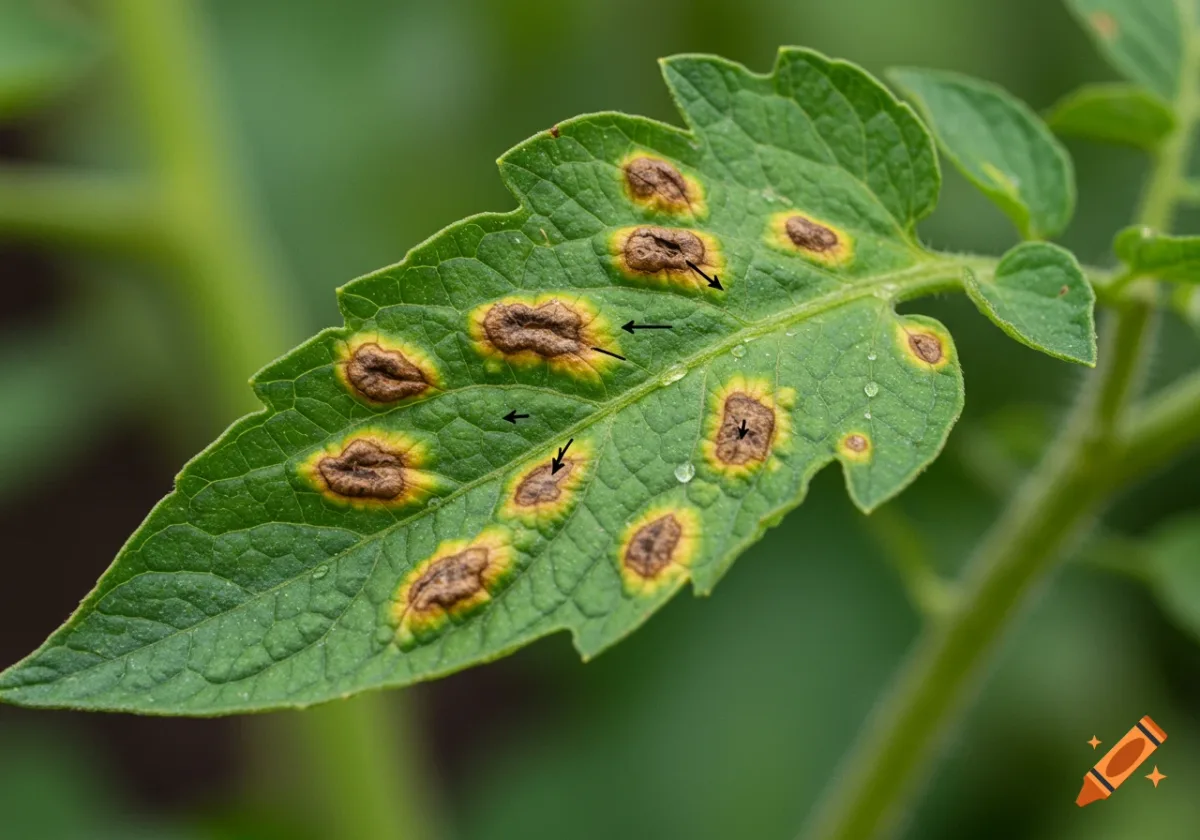
Are brown spots on tomato leaves early blight, septoria, or something else? The honest answer is that it's usually one of three fungal culprits, but a few sneaky look-alikes can throw you off completely. Getting the ID right matters, because the wrong spray on the wrong pathogen wastes money and pushes your plants closer to total defoliation.
In our research across university extension diagnostic keys, roughly 80% of tomato leaf-spot complaints trace back to early blight (Alternaria solani), Septoria leaf spot (Septoria lycopersici), or late blight (Phytophthora infestans). As of 2026, those three still dominate US and UK diagnostic reports. The rest come from bacterial disease, nutrient issues, or environmental stress.
Here's how to tell them apart before you touch anything in the shed.
Quick Answer
Brown spots on tomato leaves are most often early blight, Septoria leaf spot, or late blight. Early blight shows concentric bullseye rings on the oldest bottom leaves. Septoria makes tiny circular spots with pale centers and pinhead-sized black dots inside.
Late blight causes greasy dark patches with white fuzz on the underside. Bacterial diseases, spider mites, and nutrient issues cause most of the rest.
Why a Correct Diagnosis Matters Before You Reach for a Spray
Copper won't fix a magnesium deficiency. Chlorothalonil won't stop bacterial speck from spreading. Every wrong spray costs money and burns one more strike on your fungicide rotation before resistance builds up.
Correct ID also decides whether you snip a few leaves or pull the whole plant. Late blight can wipe out a bed in under a week during cool, wet weather. Per USDA reporting, it stays a regulated concern in commercial production, and hobby gardens can seed outbreaks in nearby farms.
There's a third reason. Fungicides carry pre-harvest intervals, and organic growers work from a narrow OMRI-approved list. Catch the disease in the first 48 hours of symptoms, and you almost always have more (and cheaper) options.
The Fast Visual Check: What Kind of Brown Spot Are You Actually Looking At
Before diving into each disease, walk your plant with three questions in mind.
- Where on the plant are the spots? Bottom leaves first points to a soil-splashed fungus. Top leaves first points to bacterial or airborne spread.
- What size and shape? Tiny dots (1 to 3 mm) point to Septoria or bacterial disease. Larger targets (5 to 15 mm) point to early blight or target spot.
- Anything inside the spot? Pinpoint black dots in a pale center is the Septoria smoking gun. Concentric rings mean early blight.
Grab a hand lens (10x is plenty) and check both sides of a fresh lesion. A phone camera on macro mode works in a pinch.
Per the American Phytopathological Society, visual scouting still handles the vast majority of home-garden diagnoses correctly. Lab confirmation is reserved for outbreaks or genuinely unusual symptoms.
Early Blight Up Close: Bullseye Rings on the Oldest Leaves
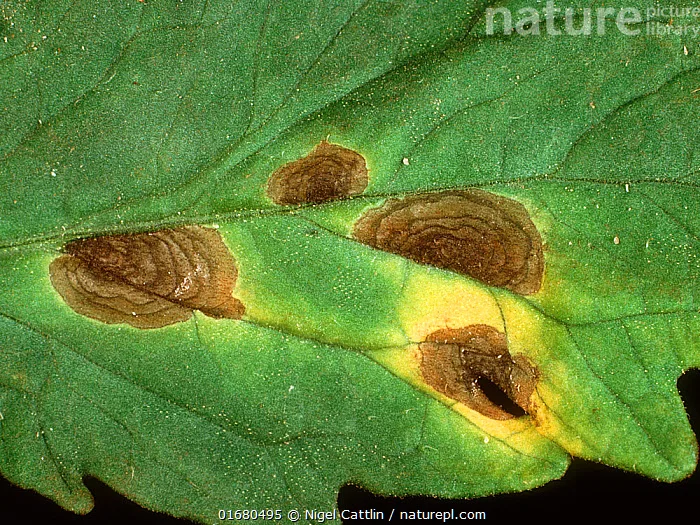
Early blight is the one most gardeners see first. It's caused by Alternaria solani (with A. linariae now recognized as a co-culprit). It hits the oldest, lowest leaves first and works its way up the plant.
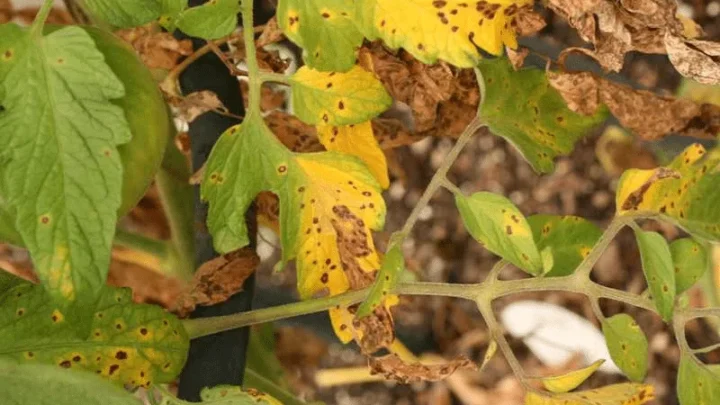
The classic sign is the concentric ring pattern. Think of a shooting target: a dark brown center with visible rings around it, often circled by a yellow halo. Spots run 5 to 12 mm wide and merge as they grow.
Look for these confirmers:
- Yellowing (chlorosis) around each spot before the leaf drops
- Dark cankers on stems near the soil line
- Sunken ringed lesions on ripe fruit near the stem
- Warm humid weather in the 75 to 85°F (24 to 29°C) range for several days
If you catch it early, strip the infected lower leaves, mulch heavily to block soil splash, and rotate a chlorothalonil or copper product on label intervals. Susceptible heirlooms take the biggest hit. Resistant hybrids like Iron Lady, Mountain Magic, and Defiant tolerate it well.
Septoria Leaf Spot Up Close: Tiny Black Dots Inside Pale Centers
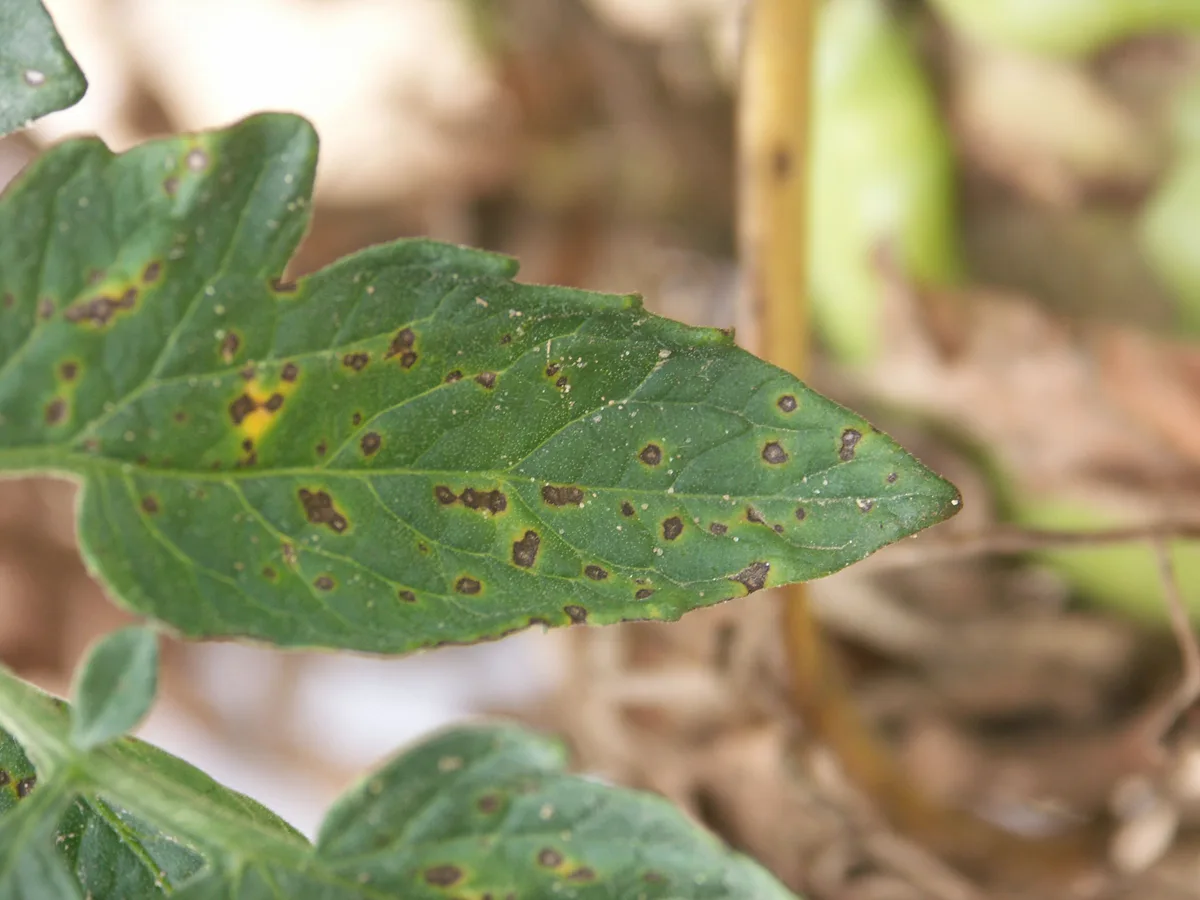
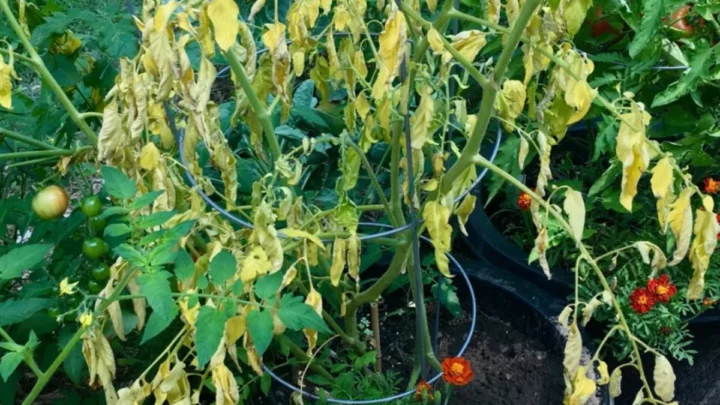
Septoria leaf spot (Septoria lycopersici) is the one people most often confuse with early blight. The plants get hammered from the bottom up, leaves yellow and drop, and panic sets in fast.
Here's what tells Septoria apart. The spots are small and uniform, usually 1.5 to 3 mm across. Each one has a pale gray or tan center with a darker brown border.
Inside that pale center, under a hand lens, you'll see tiny black dots. Those are pycnidia, the fungal fruiting bodies. No other common tomato disease produces them.
Septoria loves 60 to 80°F (15 to 27°C) with high humidity and long leaf-wetness periods. A rainy week in July is prime time. Guidance from Cornell Cooperative Extension notes that spore release ramps up sharply once foliage stays wet for 48 hours or more.
The response looks a lot like early blight. Strip the lowest infected leaves. Mulch.
Water at the base only. Rotate an approved fungicide on a 7 to 10 day schedule while conditions still favor infection.
Late Blight Up Close: Greasy Patches and White Fuzz Underneath
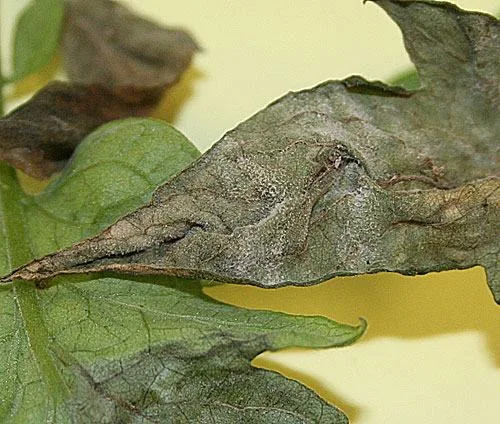
Late blight is the serious one. Phytophthora infestans is technically an oomycete, not a true fungus, and it's the pathogen behind the Irish Potato Famine. Under the right weather, it can turn a healthy tomato plant to mush in three to five days.
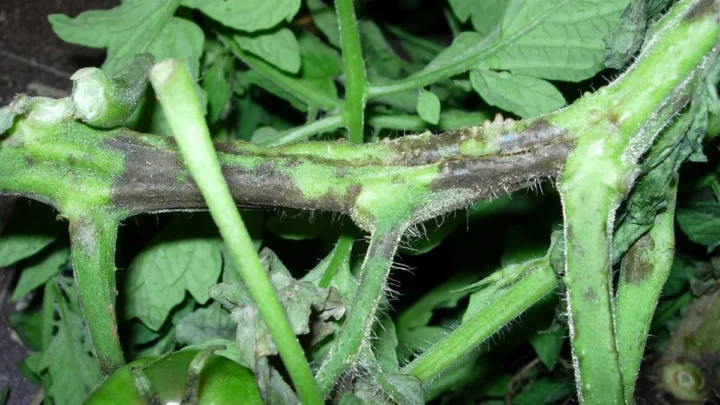
The lesions look different from anything else. Large, irregular, greasy patches in olive green to dark brown. No neat rings.
No clean edges. Flip the leaf on a humid morning and you'll often see a fine white fuzz along the border of the lesion. That fuzz is active sporulation, and it confirms late blight faster than any other single sign.
Fruit gets firm brown greasy patches too, even on green tomatoes. Whole stems can blacken and collapse within days.
Late blight favors cool wet weather, roughly 60 to 70°F (15 to 21°C) with sustained leaf wetness. If you suspect it, act the same day:
- Bag and bin infected plants. Do not compost them.
- Report suspected outbreaks through USAblight so nearby growers get an alert.
- Apply a labeled protectant fungicide to surviving plants right away.
- Check the regional outbreak map before assuming your area is clear.
Bacterial Spot vs. Bacterial Speck: Small, Dark, and Angular
Bacterial diseases fool people because the early lesions look like a fungal pinprick. The give-away is the shape and behavior. Bacterial spot (Xanthomonas spp.) and bacterial speck (Pseudomonas syringae pv. tomato) both make small dark lesions, but they follow leaf veins and often look angular rather than round.
Bacterial spot lesions run 2 to 4 mm, dark brown, sometimes with a faint yellow halo. On fruit, they scab up with rough raised edges. Bacterial speck is smaller, closer to 1 to 2 mm, jet black, and often surrounded by a bright yellow halo on the leaf.
Two big tells separate bacteria from fungi:
- Water-soaked appearance in early lesions, especially on the leaf underside
- Rapid spread after warm rain or overhead irrigation, not after long humid nights
Copper is the go-to protective spray, but as of 2026, copper-resistant strains are widespread. Rotate with a labeled bactericide, and drop overhead watering completely. There is no cure once symptoms hit hard.
Target Spot and Gray Leaf Spot: The Less Common Look-Alikes
Target spot (Corynespora cassiicola) shows up more in the humid southeast US and in greenhouses. The lesions do form concentric rings like early blight, but they usually appear on upper leaves first, not the lowest ones. They also punch clean holes as the tissue dries and falls out.
Gray leaf spot (Stemphylium spp.) is a smaller-scale issue on tomatoes but common on peppers and other Solanaceae. Look for tiny brown flecks that turn gray-brown in the center and crack out, leaving a shot-hole appearance. Lower leaves yellow and drop fast.
Both respond to the same integrated program: airflow, mulching, drip irrigation, and a rotated protectant fungicide. If you see shot-hole damage combined with a ringed lesion, target spot is the more likely call.
Non-Disease Culprits That Fool Almost Everyone
Sometimes the spots aren't a disease at all. This is where a lot of gardeners spray something they didn't need, and the plant keeps declining anyway.
Magnesium and Potassium Deficiency
Magnesium deficiency shows as interveinal yellowing on older leaves, with brown scorch spreading from the leaf margins inward. The veins stay green. Potassium deficiency looks similar but browns the edges first and can crinkle the leaf.
Neither one leaves a defined lesion with a border. A foliar spray of Epsom salt (1 tablespoon per gallon) confirms magnesium in about a week if the new growth greens up.
Sunscald, Wind Burn, and Cold Injury
Sunscald burns papery tan patches on leaves suddenly exposed to full sun after cloudy weather or heavy pruning. Wind burn produces symmetrical marginal browning along the windward side. Cold injury after a spring dip below 45°F (7°C) shows as bronze-purple mottling that later browns.
None of these have pycnidia, rings, or halos.
Spider Mites, Thrips, and Herbicide Drift
Spider mite damage looks like fine yellow stippling that runs together into bronze patches. Flip the leaf and check for fine webbing near the veins. Thrips leave silvery streaks and dark frass specks.
Herbicide drift, especially from 2,4-D, twists and cups new growth without producing spots at all. Rule these out before spraying any fungicide.
Side-by-Side Identification Table for the Big Four
Print this or bookmark it on your phone before you walk the beds.
| Feature | Early Blight | Septoria Leaf Spot | Late Blight | Bacterial Spot |
|---|---|---|---|---|
| Pathogen | Alternaria solani | Septoria lycopersici | Phytophthora infestans | Xanthomonas spp. |
| Where it starts | Oldest bottom leaves | Oldest bottom leaves | Upper canopy, any leaf | Any leaf, often mid-plant |
| Spot size | 5 to 12 mm | 1.5 to 3 mm | Large, irregular | 2 to 4 mm |
| Ring pattern | Bullseye rings, clear | None | None | None |
| Inside the spot | Dark brown center | Pale center with black pycnidia | Greasy, no border | Dark, sometimes water-soaked |
| Underside sign | None | Faint pycnidia | White fuzzy sporulation | Water-soaked halo |
| Weather trigger | Warm and humid, 75 to 85°F | Warm and wet, 60 to 80°F | Cool and wet, 60 to 70°F | Warm rain, splash |
| Speed to plant death | Slow, weeks | Moderate, 2 to 4 weeks | Fast, 3 to 7 days | Moderate |
Match your leaf against three rows at minimum before calling it. Any single trait can be misleading.
Where the Spots Appear: Bottom-Up vs. Top-Down Patterns
Where the disease starts on the plant is one of the fastest sorting tools you have. It's often the first clue that narrows the field from six suspects to two.
Bottom-up spread means the pathogen is coming from the soil or old debris. Spores splash up during rain or overhead irrigation. Early blight and Septoria almost always follow this pattern.
The lowest leaves yellow and drop while the top of the plant still looks fine.
Top-down or scattered spread points to airborne or insect-borne pathogens. Late blight arrives on wind-blown spores and lands anywhere on the canopy. Bacterial diseases often ride in on wet weather or contaminated seed and show up in the middle or upper leaves first.
A quick sorting shortcut:
- Only bottom leaves affected, spots grow slowly: early blight or Septoria
- Bottom and middle at once, fast spread after rain: late blight
- Middle to upper leaves with angular dark spots: bacterial spot or speck
- Random single-leaf damage with no spread: abiotic (sunscald, cold, drift)
Note where the first spots showed up and take a phone photo the same day. That single reference frame speeds up every diagnosis that follows.
The Hand Lens Test: How to Spot Pycnidia in 30 Seconds
A 10x hand lens is the cheapest diagnostic tool you'll ever buy, and it settles most Septoria calls in under a minute. Pick a lesion that's mature but not fully dried out. The pale center should still be intact.
Hold the lens close to your eye and bring the leaf up to it (not the other way around). Look inside the pale center of the spot. If you see dark specks that look like grains of black pepper, you've found pycnidia.
That's Septoria confirmed.
If the center is smooth with only concentric rings, it's early blight. If there's a fine white bloom along the edge, flip the leaf and check the underside for that sporulation halo. Any phone with a macro lens attachment works nearly as well as a real hand lens for photo evidence.
Weather and Timing Clues That Narrow It Down
Each pathogen has a weather signature that's almost as reliable as the spot itself. Track the last 7 to 10 days of conditions before the first symptoms appeared.
| Recent weather | Most likely culprit |
|---|---|
| Warm days, humid nights, dew heavy on lower leaves | Early blight |
| Prolonged rain, warm and damp, cool nights | Septoria |
| Cool wet stretch, temps stuck at 60 to 70°F, foggy | Late blight |
| Warm thunderstorm followed by heat | Bacterial spot or speck |
| Sudden heat spike after cloudy week | Sunscald (not disease) |
Leaf wetness is the shared trigger. Most fungal spores need 6 or more hours of continuous wet foliage to infect. Cut that window with drip irrigation and morning-only watering, and you break the disease cycle before it starts.
What to Do the Moment You Confirm the Diagnosis
The first hour matters more than the next week. Fast action on day one usually saves the plant, while a wait-and-see approach almost always costs the harvest.
Same-day steps for early blight, Septoria, or target spot:
- Prune off every visibly infected leaf and bag it (do not compost)
- Sanitize pruners between plants with 70% isopropyl or a 10% bleach dip
- Lay down clean straw or wood-chip mulch to block soil splash
- Switch to base-only watering, morning if possible
- Apply a labeled protectant fungicide within 24 hours, then rotate on the label interval
For late blight, escalate. Pull and bag entire infected plants. Notify neighboring growers if you're in a farming area.
Per USDA APHIS guidance, unmanaged home-garden outbreaks are a well-documented source of commercial infections.
Mistakes That Turn a Small Outbreak Into a Lost Crop
The single most common mistake is spraying without knowing what you're spraying for. Copper does nothing to a magnesium deficiency. Chlorothalonil won't slow bacterial spot.
The plant keeps declining, and now the disease has a week's head start.
Other frequent misses we see in aggregate extension reports:
- Overhead watering after symptoms appear, which spreads spores across the whole bed
- Composting infected debris, which returns overwintering inoculum to next year's soil
- Skipping crop rotation and planting tomatoes in the same spot 3 years running
- Waiting until 30% or more of the foliage is dead before treating
- Cramming plants together with no airflow, then blaming the weather
One rotation slip won't ruin your garden. Doing three at once almost guarantees you'll lose the crop.
Resistant Varieties Worth Planting Next Season
If the same disease hits your patch year after year, the fastest fix is at the seed catalog. Resistant cultivars won't be immune, but they'll shake off pressure that flattens heirlooms.
Cultivars with documented resistance breeding as of 2026:
- Iron Lady: strong against early blight, late blight, and Septoria
- Mountain Magic: high late blight tolerance, good disease package
- Defiant PhR: bred for late blight and early blight resistance
- Plum Regal: paste tomato with late blight resistance
- Jasper: cherry tomato with good late blight tolerance
- Mountain Merit: large slicer with a broad disease resistance profile
Pair a resistant variety with the cultural basics (mulch, spacing, drip irrigation, 3-year rotation) and most gardens can drop fungicide use dramatically. Heirlooms stay in the mix, but plant them upwind and give them the best airflow spot in the bed.
When to Send a Sample to Your Cooperative Extension Lab
Send a sample when the symptoms don't match any of the profiles above, when a resistant variety is failing anyway, or when losses are spreading fast despite treatment. Most US land-grant universities run a plant diagnostic clinic for $15 to $30 per sample. In the UK, the RHS Gardening Advice service handles member submissions.
Ship a fresh leaf with active lesions, not fully dried tissue. Include recent photos of the whole plant and note the weather for the past 10 days.
Frequently Asked Questions
Can I eat tomatoes from a plant with early blight or Septoria?
Yes, the fruit is safe as long as it looks and smells normal. Both diseases hit leaves first and rarely spoil the fruit. Cut away any lesioned areas on affected tomatoes and use the rest as usual.
Will neem oil actually stop these diseases?
Neem oil offers mild preventive activity against early blight and Septoria, but it won't rescue an established outbreak. It works best rotated with a stronger protectant, applied every 7 days during humid stretches.
Should I pull the whole plant or just strip infected leaves?
Strip leaves for early blight, Septoria, target spot, and bacterial issues if under 30% of the plant is affected. Pull and bag the whole plant for confirmed late blight, no exceptions.
How long can these pathogens survive in the soil?
Early blight and Septoria overwinter on debris and in soil for 1 to 2 years. That's why a 3-year rotation off tomatoes, peppers, potatoes, and eggplants is the baseline recommendation from most extension services.

Similar Posts