Why Aren’t My Onion Bulbs Forming? 7 Common Causes
"Why aren't my onion bulbs forming?" is one of the most frustrating questions in the vegetable garden. The answer almost always traces back to two decisions you made months earlier: the variety you planted and where you live. If your onions have big leafy tops sitting over marble-sized bulbs, the plant isn't broken.
It just never got the right signal to switch from leaves to bulb.
Onions are photoperiod-sensitive, meaning they start bulbing only once daylight crosses a specific threshold. That trigger runs from 10 to 16 hours depending on variety. Match the wrong type to your latitude and no amount of water or fertilizer will make a bulb.
As of 2026, extension research still ranks variety-to-latitude mismatch as the top cause of failed onion crops.

Quick Answer
Onion bulbs don't form when the variety doesn't match your latitude. Short-day onions need 10 to 12 daylight hours to bulb. Long-day varieties need 14 to 16.
Plant the wrong one and you get all tops, no bulb. Excess nitrogen, late planting, and tight spacing make it worse.
Onions Growing Tops But No Bulbs: What's Actually Going Wrong
An onion grows in two phases. First it builds foliage. Then, once daylight crosses a set number of hours, it flips a switch and starts pushing energy down into a bulb.
If that switch never flips, you get scallions instead of onions.
That's what most "failed" onion crops actually are. Healthy plants that stayed in the leaf phase forever. The fix isn't more fertilizer or more water.
It's finding out which trigger went missing.
Here are the real culprits, roughly in order of how often they show up:
- Wrong day-length variety for your latitude
- Planted too late in spring
- Too much nitrogen once bulbing should have started
- Onions crowded closer than 4 inches
- Sets planted too deep or too large
- Cold snap in early growth causing the plant to bolt
Work through them in that order and you'll usually land on the answer within one or two checks.
The Single Biggest Reason Onion Bulbs Don't Form: Day Length vs Latitude
This is the biggest fix in onion growing. Variety must match your latitude. That single decision drives whether your plants ever bulb at all.
Here's the rule. Onions bulb in response to daylight, not warmth. Short-day varieties start bulbing at 10 to 12 hours of daylight.
Long-day varieties wait until 14 to 16 hours.
If your summer day length never reaches your variety's trigger, the plant stays in scallion mode all season.
The rough dividing line in the United States runs across the 35th to 38th parallel. Georgia, Texas, Florida, and southern California sit in short-day country. Iowa, Ohio, Oregon, New York, and most of Canada are long-day country.
The middle band works best with intermediate-day types.
Plant a long-day onion in South Texas and it never sees a 14-hour day. It just grows tops all summer. Plant a short-day onion in Minnesota and it bulbs too early on a tiny plant.
You'll pull golf-ball-sized onions in June.
For a deeper regional breakdown, Texas A&M AgriLife Extension publishes some of the most cited short-day onion research in the country. Check the seed packet or transplant label before you buy. It'll say short-day, intermediate, or long-day.
How Onion Bulbing Actually Works (Leaves, Day Length, and the "One Ring Per Leaf" Rule)
An onion plant grows one leaf at a time from the center. Each leaf you see above ground forms a matching ring inside the bulb below. That's the classic "one leaf, one ring" rule commercial growers plan around.
Bigger bulbs need more leaves before bulbing starts. Aggregate extension research points to 10 to 13 mature leaves as the target for jumbo bulbs. Fewer leaves at bulbing means fewer rings, which means a smaller onion no matter what you do after.
Here's the tricky part. Once day length triggers bulbing, leaf production essentially stops. The plant redirects everything into swelling the rings it already has.
So if you plant late and your onion only has 5 or 6 leaves when the daylight trigger hits, that's it. You've capped your maximum bulb size before summer even starts.
This is why "plant as early as your soil can be worked" is the single best piece of onion advice you'll ever get. Every extra week of cool-season leaf growth adds ring capacity. Every week of delay costs you bulb size.
Warm soil doesn't grow bigger onions. More leaves before the summer solstice does.
Short-Day, Intermediate-Day, and Long-Day Onions: Which One You Should Be Growing
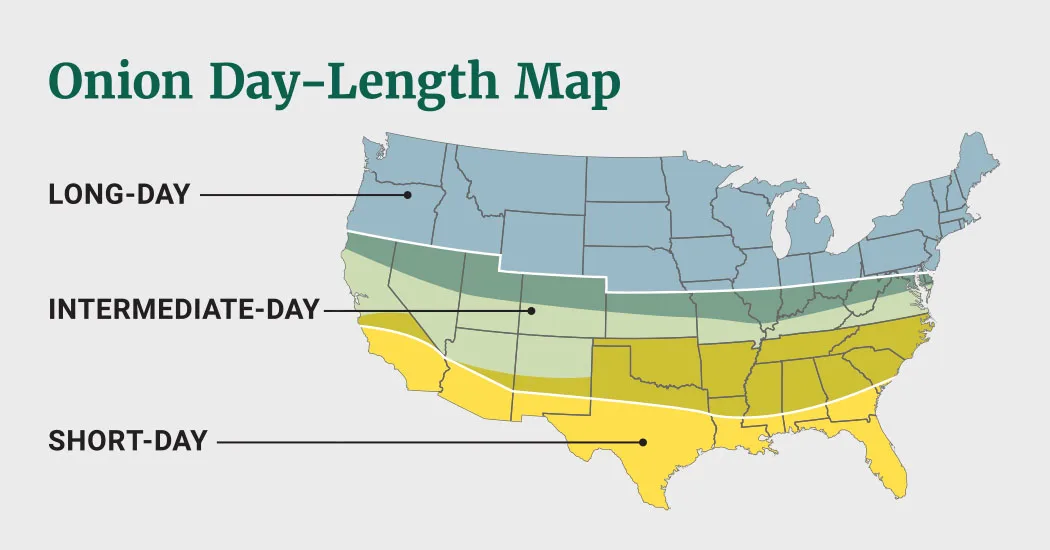
This is the decision most "no-bulb" problems come down to. Use the table below to match your growing region to the right variety group.
| Variety Type | Daylight Trigger | Best Latitude | Well-Known Varieties |
|---|---|---|---|
| Short-day | 10 to 12 hours | Below 35°N (Deep South, Gulf Coast, southern CA) | Texas Grano, Yellow Granex (Vidalia), Red Creole |
| Intermediate-day | 12 to 14 hours | 32°N to 42°N (mid-South, lower Midwest, mid-Atlantic) | Candy, Red Candy Apple, Cabernet |
| Long-day | 14 to 16 hours | Above 37°N (northern US, Canada, UK) | Walla Walla, Yellow Sweet Spanish, Patterson, Copra |
| Day-neutral | Bulbs regardless of daylight | Most zones as a safety option | Superstar, Sierra Blanca |
A few things worth knowing before you buy:
- Sweet onions (Vidalia, Walla Walla, Texas 1015Y) store poorly. Weeks, not months.
- Storage onions like Copra and Patterson cure hard and keep 6 to 9 months.
- Day-neutrals are the "if I'm not sure" pick. They'll bulb across most of the continental US.
If you sit right on a dividing line, go with the intermediate-day or a day-neutral variety. Missing your latitude by a degree or two is exactly what turns a promising crop into a row of oversized scallions.
Overwintered onions play by slightly different rules. In the Pacific Northwest and UK, growers plant hardy long-day varieties in fall so they build leaves through winter and bulb the following summer. If that's your setup, look for "overwintering" cultivars like Bridger or Walla Walla.
Quick Diagnostic: Match Your Symptoms to the Real Cause
Different failures look different in the row. Find the description that matches what you're actually seeing.
Tops Are Huge, Bulbs Are Tiny
Classic photoperiod mismatch or nitrogen overload. If the variety is right for your latitude, look at your fertilizer schedule. Nitrogen fed past the start of bulbing tells the plant to keep pushing leaves instead of swelling the bulb.
Fix for next year:
- Confirm the variety matches your latitude first
- Stop nitrogen feeding as soon as bulbs start visibly widening
- Switch to a low-nitrogen, higher-potassium feed after mid-season
Onions Bolted and Flowered Instead of Bulbing
Bolting almost always traces back to cold stress on a plant that's already past a certain size. This happens most often when onion sets larger than 3/4 inch go into cold spring soil. The plant thinks it survived winter and jumps straight to flowering.
Fix for next year:
- Use sets smaller than a dime (under 3/4 inch across)
- Grow from transplants or seed for more control over size at planting
- Wait until soil is workable but not freezing at night
Bulbs Started Then Stalled
Usually a watering or spacing issue. Onions need consistent moisture during the bulking phase, roughly 1 inch per week. Let them dry out for a stretch and the bulb pauses.
It rarely catches back up to full size.
Fix for next year:
- Mulch 2 to 3 inches deep to steady soil moisture
- Water deeply once or twice a week, not shallow daily
- Space plants 4 to 6 inches apart minimum
Necks Are Thick and Won't Cure
Thick, soft necks mean the plant was still in leaf-growth mode at harvest. Excess late-season nitrogen is the usual cause. So is planting sets too deep, which forces the neck to elongate.
Fix for next year:
- Cut off nitrogen 3 to 4 weeks before expected harvest
- Plant so the top of the bulb sits right at the soil surface
- Let tops fall over naturally before pulling, then cure 2 to 3 weeks
For region-specific troubleshooting, Oregon State University Extension publishes free growing guides tailored to Pacific Northwest conditions.
Planting Timing Mistakes That Kill Bulb Formation
Onions run on a calendar, not a thermometer. Every week you wait to plant is a week of leaf growth you'll never get back. Once the daylight trigger hits, your leaf count is locked in.
For long-day zones, get transplants in the ground 4 to 6 weeks before your last frost. For short-day zones, plant in fall or very early winter so plants build foliage through cool months. Waiting for "nice weather" is the most common timing mistake we see.
If you missed the window this year, don't try to make up for it with more fertilizer. Just note the date and beat it by a month next season. Cool wet soil grows onions perfectly well.
Warm soil rushes them to bulb before they've built a real plant.
Nitrogen, Potassium, and the Fertilizer Trap That Feeds Leaves Instead of Bulbs
Fertilizer timing matters more than fertilizer amount. Nitrogen fuels leaves. Potassium and phosphorus build bulbs.
Keep feeding nitrogen once bulbing starts and the plant stays stuck in leaf mode.
A workable feeding schedule looks like this:
- Early growth: side-dress with a balanced fertilizer every 2 to 3 weeks
- First sign of bulb swell: stop nitrogen completely
- Bulking phase: switch to a low-nitrogen mix higher in potassium
- 3 to 4 weeks before harvest: stop all feeding
Soil pH also matters. Onions prefer 6.0 to 6.8. Outside that range, they can't take up phosphorus properly no matter how much you add.
A cheap soil test kit will tell you where you stand.
Aged compost is safer than fresh manure. Fresh manure delivers a nitrogen spike right when the plant needs to slow down.
Spacing, Depth, and Weed Pressure: The Physical Reasons Bulbs Stay Small
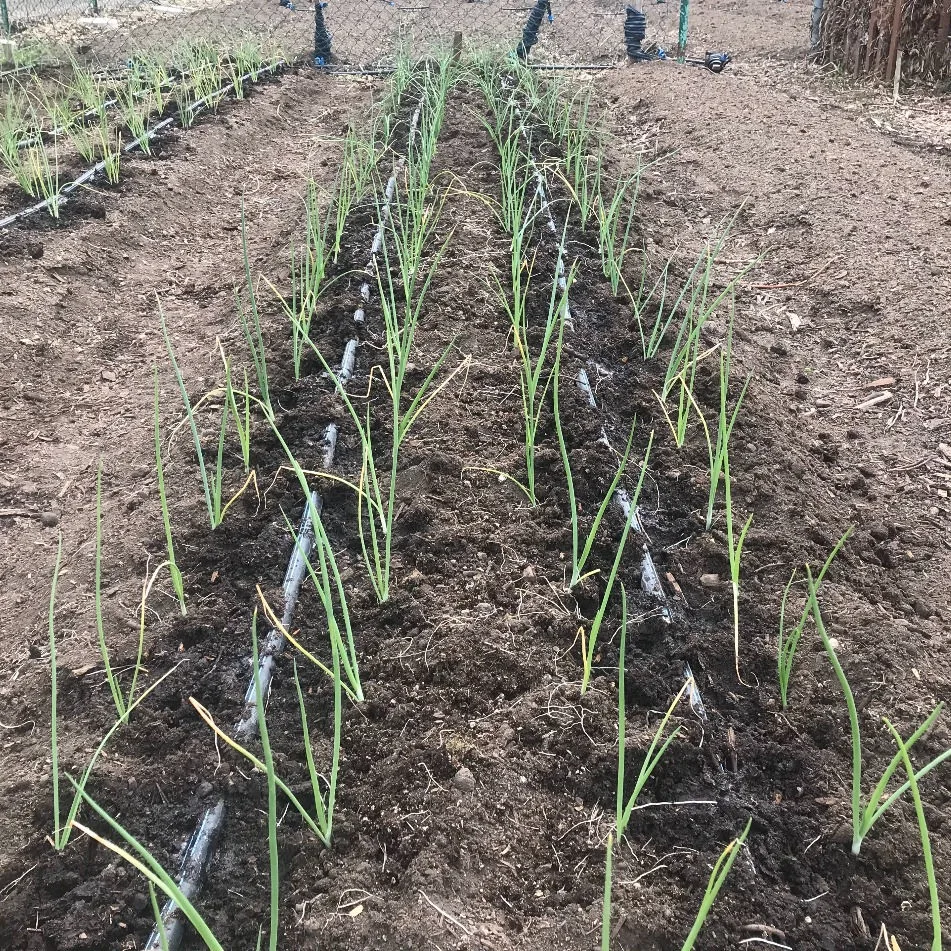
Bulb size follows the space you give each plant. Crowd them and you get small onions no matter how good your soil is. Space them properly and each one reaches the size its variety allows.
Target spacing:
- 4 inches apart for pearl or pickling onions
- 5 to 6 inches apart for standard cooking onions
- 6 inches apart for jumbo storage varieties
- 12 inches between rows
Depth matters just as much. Set transplants shallow. The top of the bulb should sit right at or just above the soil surface.
Bury the shoulders and the neck stretches, delaying bulbing.
Weeds are the silent killer. Onion foliage doesn't shade the ground, so any weed steals sun and nutrients directly from the crop. Mulch or hand-weed weekly, especially in the first six weeks.
Watering Errors During the Bulking Phase
Onions want steady moisture from planting until the tops start to fall over. Roughly 1 inch per week from rain or irrigation. Inconsistent watering during the bulking phase is a top cause of small or split bulbs.
The pattern to avoid: dry, then flood, then dry again. That yo-yo triggers double bulbs, cracked skins, and stalled growth. Deep watering once or twice a week beats shallow daily sprinkles every time.
Roughly 2 weeks before you expect to harvest, cut water back sharply. Dry soil helps the necks soften and the outer skins tighten. That's what makes a bulb store well instead of rotting in the pantry.
Drip irrigation on a timer is the easiest way to get this right. It removes the human factor from a crop that punishes forgotten weeks hard.
Sets vs Transplants vs Seed: Why Your Starting Material Might Be the Problem
Your starting material sets the ceiling on what the crop can do. Each option has real trade-offs worth knowing before you shop.
| Starting Material | Best For | Main Risk |
|---|---|---|
| Sets (small dry bulbs) | Beginners, quick scallion crops | Bolting if larger than 3/4 inch |
| Transplants (pencil-thick seedlings) | Best all-around for big bulbs | Cost per plant, limited variety choice |
| Seed (started 10 to 12 weeks early) | Widest variety choice, biggest final bulbs | Longest lead time, indoor setup required |
Sets are the most common source of "no bulb" failures. Anything larger than a dime often bolts instead of bulbing. If you're buying sets, pick through the bin for the smallest ones.
Transplants ship in bundles from specialty growers like Dixondale Farms and Territorial Seed. They're the sweet spot for most home gardens. Fast to plant, high success rate, and they hit big final bulb size when timing is right.
Seed offers the most variety control but demands the earliest start. In cold zones, start seed indoors in January or early February to hit that April transplant window. Miss the head start and you're better off buying transplants.
Temperature, Bolting, and Cold-Snap Damage

Bolting is what happens when an onion flowers instead of bulbing. The plant sends up a thick central stalk topped with a papery flower. Once that happens, the bulb stops growing for good.
Two triggers cause it: cold stress on plants already past pencil thickness, or wild swings between warm days and freezing nights. Sets planted too early in cold soil are the biggest offender. Aim for daytime soil around 50°F at planting.
Spot the flower stalk forming? Snap it off immediately. You'll get a smaller bulb, but at least you'll get one.
Bolted onions won't cure or store, so eat those fresh.
Pests and Diseases That Stunt Bulbing
Onion thrips are the number one insect problem. They scrape leaves and silver them, cutting photosynthesis and shrinking bulb size. Look for tiny yellow specks along leaf blades and treat with insecticidal soap or spinosad if populations climb.
Onion maggots tunnel into the base and rot the plant from below. Floating row cover at planting stops them cold. For soil-borne diseases like pink root and Fusarium basal rot, rotate onions on a 4-year cycle.
Never plant them in the same bed two years running.
Region-by-Region Fixes
Deep South (Zones 8 to 10): Plant short-day transplants in October or November. Harvest by early summer before humidity spikes disease pressure.
Midwest (Zones 4 to 6): Long-day transplants in early April. Watch for late frosts that trigger bolting in exposed rows.
Pacific Northwest: Long-day or overwintering varieties. Fall plantings of Walla Walla types perform well thanks to mild wet winters.
Northeast: Long-day transplants as soon as soil can be worked. Row cover helps stabilize temperatures through April.
UK: Long-day varieties or sets planted March to April. Autumn sets like Radar and Senshyu overwinter for early July harvests.
Mistakes to Avoid Next Season
Quick list of what to change before you buy seed or sets again:
- Buying based on price instead of day-length label
- Planting sets larger than 3/4 inch
- Fertilizing with high-nitrogen feed after bulbs start swelling
- Setting transplants too deep, covering the shoulders
- Skipping mulch and letting weeds compete for light
- Watering shallow and inconsistent through the bulking phase
- Harvesting before at least half the tops have fallen naturally
Fix any three of these and you'll see a noticeable jump in bulb size next year.
Frequently Asked Questions
Can I make a scallion-only crop bulb by adding more fertilizer?
No. If the variety doesn't match your latitude, no amount of feeding will trigger bulb formation. Extra nitrogen just adds more leaves and delays things further.
Pull them and use them as green onions.
How many hours of sunlight do onions need daily?
Onions need full sun for at least 12 hours to bulb well. Short-day types bulb at 10 to 12 hours of daylight, long-day types at 14 to 16. Under 6 hours of direct sun and even the right variety struggles to size up.
Why did my onions bolt in the first year?
Bolting means the plant hit a cold snap after reaching pencil thickness. Sets larger than 3/4 inch are the biggest culprit. Cold, warm, then cold spring weather triggers flowering instead of bulbing.
When should I stop watering onions?
Stop watering about 2 weeks before harvest, once tops start yellowing and softening at the neck. Dry soil helps bulbs finish and cure properly. Continued watering at this stage causes rot and weak storage life.
Your Decision Guide: What to Change Before Planting Again
Start with the two questions that solve most cases:
- What's my latitude?
- Did I plant the matching day-length variety?
If those two line up, work down the list: planting date, spacing, nitrogen timing, watering consistency, then set size.
Order of impact, highest to lowest:
- Variety matched to latitude
- Planted as early as soil allowed
- Nitrogen cut off at first bulb swell
- Spacing at 4 to 6 inches minimum
- Consistent 1 inch of water weekly
- Sets under 3/4 inch to prevent bolting
Fix number one alone and most gardens go from scallions to real bulbs. Fix the top three and you'll be pulling storage-quality onions by mid-summer.

Similar Posts