Corn Flowering But No Cobs? Here’s Why and How to Fix It
Standing over a patch of tall corn covered in tassels but no ears is one of the most frustrating moments in a home garden. If you’re asking why is my corn flowering but not producing cobs, the answer almost always comes down to pollination. Corn is a wind-pollinated plant with separate male and female flowers.
When timing, spacing, or weather is off, those two never connect.
Purdue University Extension research shows pollen viability drops sharply above 95°F, and a single tassel only sheds pollen for 5 to 8 days. Miss that window and you get bare stalks. The fix is usually simpler than most gardeners expect.
Let’s start with what’s happening inside the plant, then work through the most likely causes.

Why Your Corn Is Tasseling But Not Making Cobs (The Short Answer)
Your corn is flowering but not making cobs because pollination failed. The tassel is the male flower, and the silks belong to the female ear. If silks emerge after pollen shed ends, no kernels form.
Heat above 95°F, single-row planting, drought, and low nitrogen are the top causes. Fix spacing, water, and timing to bring cobs back next season.
How Corn Actually Flowers: Tassels, Silks, and Why Timing Matters
Corn is what botanists call a monoecious plant. Each plant carries both male and female flowers, but they sit in different spots on the stalk. The tassel at the top is the male part, and it releases pollen.
Every ear shoot lower down is a female flower. Those hair-like threads pushing out of the husk are the silks.
Here’s the part most home growers miss. Each silk is connected to one potential kernel inside the husk. For a kernel to form, a pollen grain has to land on the silk, grow down through the silk tube, and fertilize the ovule at the other end.
No pollen on that silk means no kernel in that spot.
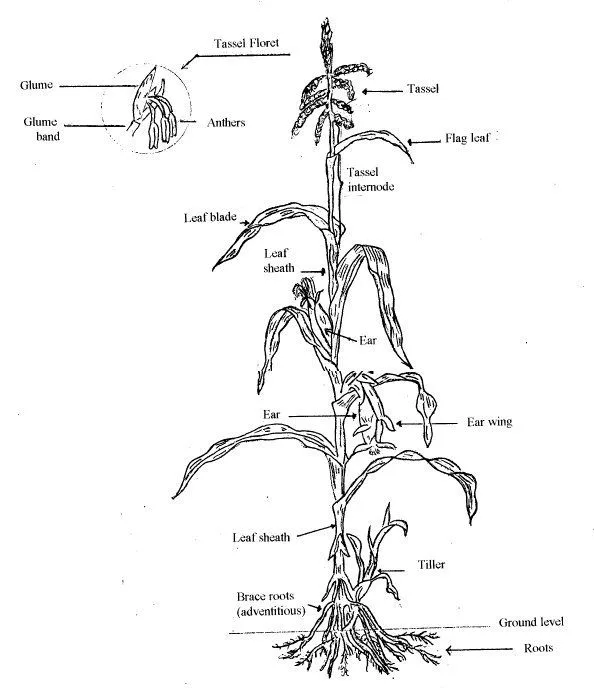
The tassel usually starts shedding pollen a day or two before silks emerge. Botanists call this protandry, and it exists to prevent self-pollination. Silks stay receptive for 7 to 10 days.
Pollen lives just 1 to 2 days after it drops. Miss that overlap, called the pollen-silk nick, and the ear stays empty even though the plant flowered right on schedule.
The Fast Diagnostic: 6 Questions to Pinpoint Your Problem
Before you replant anything, run through these six questions. Your answers tell you which cause to focus on first.
- Are silks emerging from ear shoots at all? If not, the plant hit heat or drought stress before ear formation.
- Did the tassel finish shedding pollen before silks appeared? That’s a classic nick failure.
- How many rows of corn did you plant? Fewer than 4 rows almost guarantees poor wind pollination.
- Was daytime heat above 95°F during tasseling? Pollen loses viability fast at that point.
- Did you water consistently during silking? Silks need moisture to stay receptive.
- Any yellowing on lower leaves? Nitrogen deficiency starves the developing ear.
If you said yes to two or more, you likely have overlapping causes. That’s normal. Corn is unforgiving because pollination has to hit a narrow window.
Aggregate reports from land-grant university extension services as of 2026 put single-row planting and heat stress at the top of the list every year. Work through the causes below in order.
Cause #1: You Planted Corn in a Single Row or Small Patch
This is the number one cause in home gardens. Corn is wind pollinated. Pollen drifts sideways and downward from the tassel.
If you planted a single long row, most of that pollen blows into empty air.
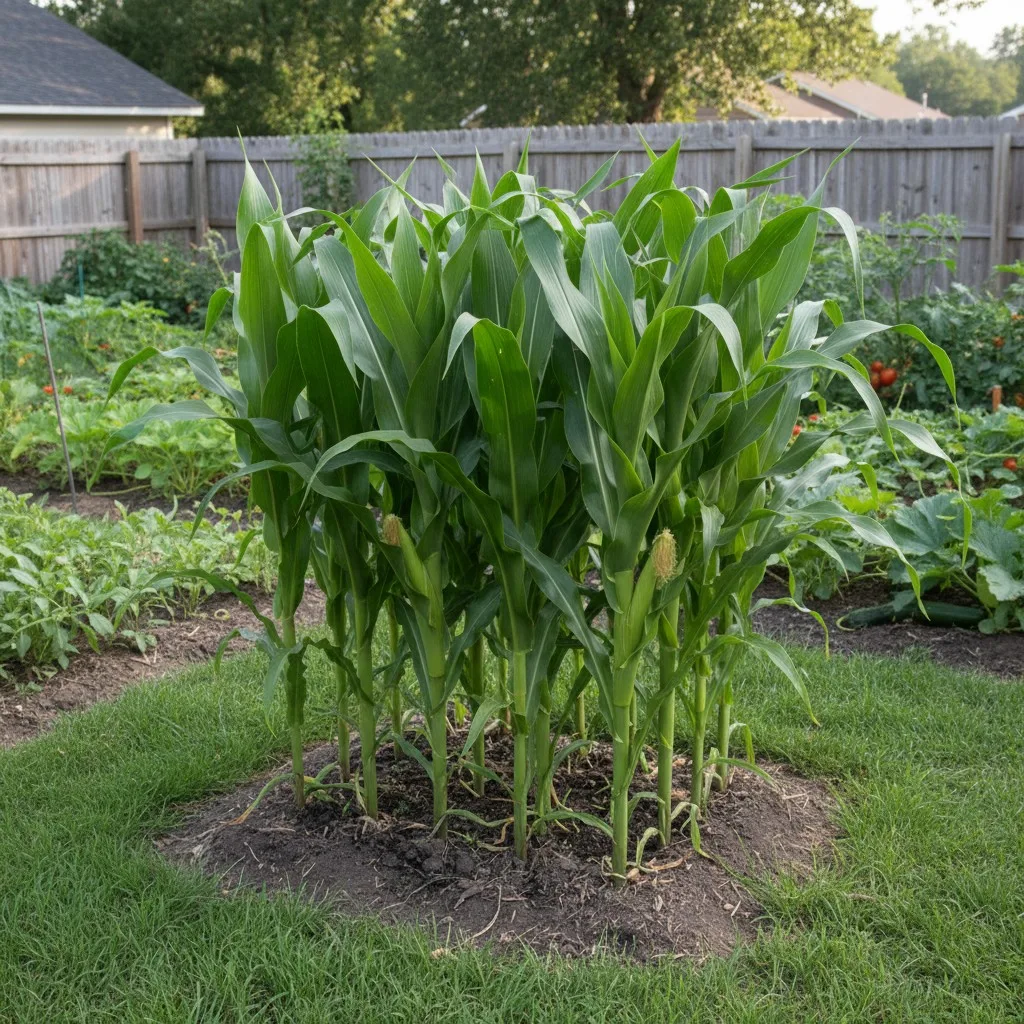
The fix is block planting. Plant in a square rather than a line. Iowa State University Extension recommends a minimum of four rows by four plants for reliable pollination.
Bigger blocks work even better.
Spacing that works
| Setting | Recommendation |
|---|---|
| In-row spacing | 8 to 12 inches between plants |
| Row spacing | 30 to 36 inches apart |
| Minimum block | 4 rows by 4 plants (16 total) |
| Ideal home block | 5 by 5 or larger |
What goes wrong in single rows
A single row exposes silks to open wind on both sides. Pollen has nothing to land on. In our research, gardeners who switched from a long single row to a 4×5 block reported full ear fill the next season with the same variety and same soil.
If space is tight, plant a short, wide block instead of a long, narrow strip. Two 3×8 patches will outperform one 1×24 row every time. Even container growers should cluster pots together in a group of at least nine.
Cause #2: Your Silks and Pollen Missed Each Other (Nick Failure)
Nick failure is the term agronomists use when tassel pollen shed and silk emergence don’t overlap. The plant flowered on schedule. The two flowers just missed each other in time.
Two situations cause it most often. First, uneven planting depth or patchy soil moisture creates plants that develop at different rates inside the same block. Second, heat or drought pushes tassels to shed early while delaying silk emergence.
You can spot nick failure by peeling back a husk on an ear that never filled. If the silks inside are brown and dry and kernels are missing across the whole cob, pollen never reached them.
How to reduce nick failure next year
- Plant seed at uniform depth, 1 to 1.5 inches deep
- Water evenly across the entire patch, not just the edges
- Plant a single variety per block rather than mixing days to maturity
- Use succession planting 10 to 14 days apart to spread the risk
If you’re still mid-season with tassels shedding and no silks yet, keep the soil consistently moist. A deep soak every 2 to 3 days beats light daily watering.
Cause #3: Heat Above 95°F Wiped Out Your Pollen
Corn pollen is delicate. Once daytime highs pass 95°F (35°C), viability drops fast. Push into 100°F and pollen can dry out within an hour of shedding.
If your tassels came out during a heat wave, most of the pollen was dead before it hit a silk. This is especially rough in the southern US and low-desert regions where July highs run long and hot.
Signs heat killed your pollen
- Tassels look bleached or brown at the anthers
- Empty ears with dry, curled silks
- Full plant vigor otherwise (deep green leaves, tall stalks)
- Kernels only at the base of the ear, none toward the tip
How to dodge heat next season
- Plant earlier so silking finishes before peak heat
- Choose a short-season variety (60 to 75 days to maturity)
- Water heavily the evening before a forecast heat spike
- In hot climates, time a fall crop for silking after temperatures ease
Verified grower reports from southern extension offices show that shifting the planting date two weeks earlier often rescues a whole season. It’s the cheapest fix for hot-summer gardens.
Cause #4: Drought Stress Hit During Silking
Silks are mostly water. When soil moisture drops during silk emergence, they either fail to push out of the husk or dry up before pollen arrives. Even one dry week at this stage can wreck a crop.
Corn’s water demand peaks at tasseling and silking. Aim for 1 to 1.5 inches per week during that window, from rain or irrigation. Skip it, and the plant sacrifices the ear to save itself.
How to spot drought-driven ear failure
- Leaves rolled tight during afternoon heat
- Silks that look short, wiry, or absent
- Ears smaller than expected with sparse kernels
- Stunted overall growth despite good spacing
Watering that actually helps
Deep soakings beat frequent light sprinkles. Water at the base of the plants, not overhead, so you don’t wash pollen off tassels during morning shed. Drip lines or soaker hoses work best for a home block.
Mulch heavily with straw or shredded leaves once plants hit knee height. That one step cuts soil moisture loss and buys you a buffer against a missed watering.
Cause #5: Nitrogen Ran Out Before Ear Formation
Corn is a heavy nitrogen feeder. It burns through nutrients between V6 (six leaves) and tasseling. If your soil ran empty at that point, the plant flowers but can’t fill an ear.
Yellowing on the lower leaves that creeps up as a V-shape is the classic tell. That’s nitrogen being pulled out of old leaves to feed new growth. The plant is starving.
Feed rates that work for home gardens
| Timing | Application |
|---|---|
| At planting | 1/2 lb actual N per 100 sq ft, mixed into soil |
| V6 (knee-high) | Side-dress 1/2 lb actual N per 100 sq ft |
| V10 to VT | Optional second side-dress if leaves yellow |
Compost, aged manure, blood meal, or a balanced granular fertilizer all work. Match the rate to a soil test if you have one. Over-fertilizing burns roots and delays silking, which creates its own nick failure problem.
Sandy soils leach nitrogen fastest. On light ground, split the feeding into three smaller doses instead of two big ones.
Cause #6: Overcrowding or Shading Is Starving the Plants
Corn crammed too tight competes for light, water, and nitrogen at the exact moment ears are forming. The result is barren stalks, tiny ears, or ears with kernels on only one side.
Aggregate research from land-grant extensions puts the sweet spot at 24,000 to 32,000 plants per acre for home-scale sweet corn. Translated for a backyard: no closer than 8 inches in-row with 30 inch row spacing.
Signs overcrowding is the culprit
- Stalks noticeably thinner than a normal pencil
- No visible ear shoot on some plants
- Small nubbin ears with 20 to 40 kernels instead of a full cob
- Lower leaves dying back early from shading
Fix it mid-season
- Thin ruthlessly at V3 to V4 (three to four true leaves)
- Pull weakest plants, keep the strongest at correct spacing
- Remove tall companion plants shading the block
- Never plant corn on the north side of taller crops
For a Three Sisters planting with beans and squash, keep the corn block dense but the surrounding plants low. Tall companions on the south or west side will steal the light corn needs at ear fill.
Cause #7: Pests, Herbicide Drift, or Smut Damaged the Ears
Sometimes the plant did everything right and something outside broke the ear. Three culprits show up most often. Corn earworms chew silks off before pollination finishes.
Sap beetles feed on damaged tips. Herbicide drift twists the ears into useless shapes.
Corn smut (Ustilago maydis) is a fungus that replaces kernels with bulbous gray galls. It looks alarming but only hits a small percentage of ears in most home gardens. In Mexican cooking those galls are prized as huitlacoche, so not everyone treats smut as a loss.
How to tell which one hit you
- Silks chewed to nubs, kernels missing at the tip: corn earworm
- Cupped, twisted leaves plus deformed ears: herbicide drift from 2,4-D or dicamba
- Gray or black swollen galls replacing kernels: corn smut
- Sunken, discolored kernels with tunneling: European corn borer
Prevention that works
- Apply a few drops of mineral oil to silk tips 5 to 7 days after silks emerge (earworm)
- Plant well away from lawns treated with broadleaf herbicides in windy conditions
- Rotate corn to a new spot each year to break smut and borer cycles
- Scout twice a week from silking through harvest
The USDA National Institute of Food and Agriculture partners with state extension services on integrated pest management guides for each region. A quick search of your state extension site pulls up local pest calendars worth bookmarking.
How to Hand Pollinate Corn When Wind Isn’t Cutting It
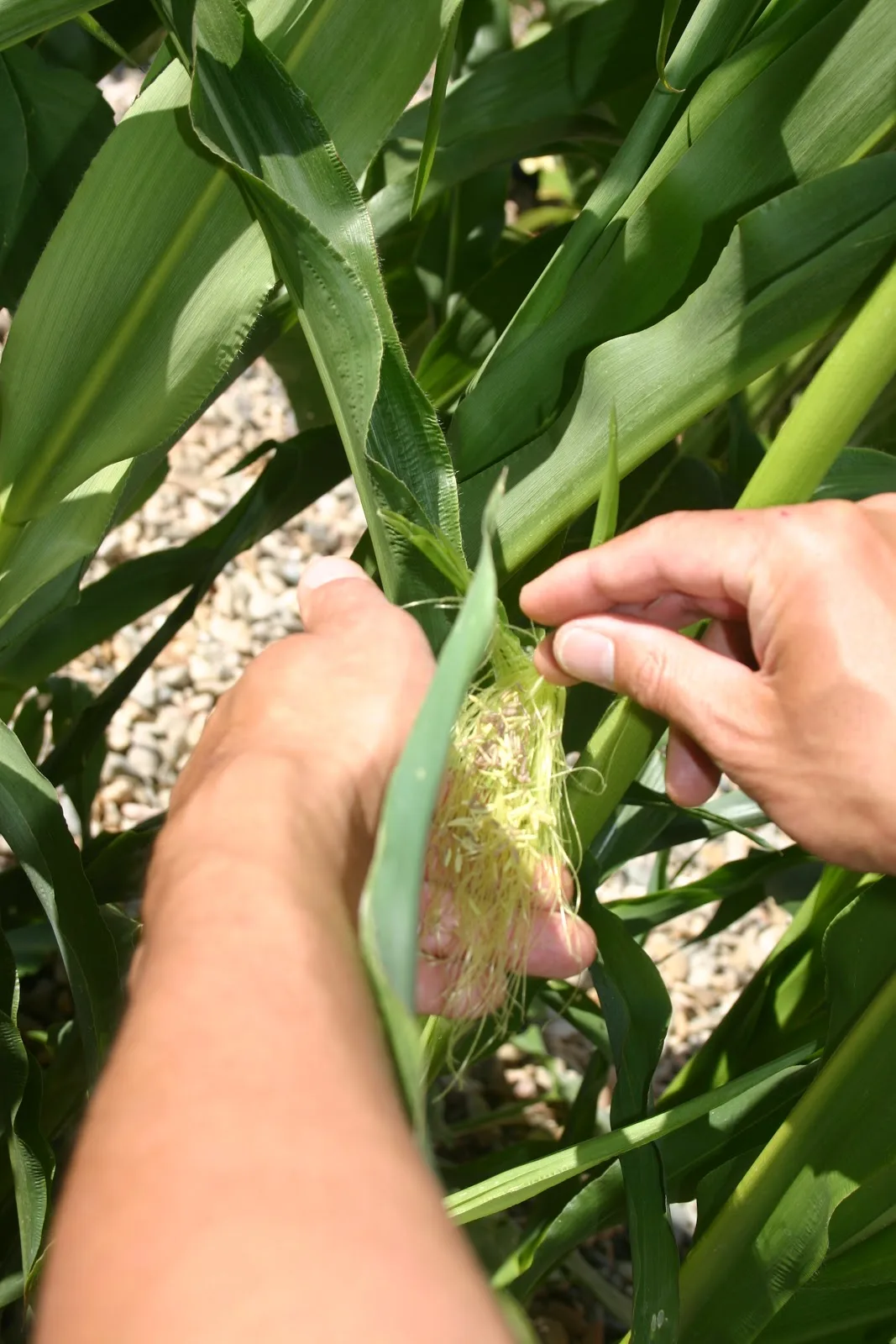
Hand pollination rescues small patches when wind won’t do the job. It takes five minutes a morning for about a week and can double kernel set.
The technique
- Wait until mid-morning after dew burns off, when pollen shed peaks
- Cup a paper bag over a mature tassel and shake gently to collect pollen
- Sprinkle the pollen directly onto fresh, sticky silks on nearby plants
- Repeat daily for 5 to 7 days across the silking window
- Alternative: bend the tassel over a receptive ear and tap it firmly
Fresh silks are pale green or light yellow and slightly damp. Brown, dry silks are already past their prime. Focus your effort on plants where silks just pushed out.
Hand pollination is most useful in blocks smaller than 4×4, container plantings, and heirloom seed-saving projects where you’re keeping varieties separate.
Spacing, Block Size, and Planting Fixes for Next Season
Most cob failures start at planting. Get the layout right in April or May and you’ll rarely fight barren stalks in August.
Planting checklist for reliable ears
| Factor | Target |
|---|---|
| Soil temperature at planting | 60°F minimum, 65 to 75°F ideal |
| Seed depth | 1 to 1.5 inches, uniform |
| In-row spacing | 8 to 12 inches |
| Row spacing | 30 to 36 inches |
| Block minimum | 4 rows by 4 plants |
| Succession interval | New block every 10 to 14 days |
Pick one variety per block. Mixing supersweet (sh2), sugar-enhanced (se), and standard (su) types in the same patch causes cross-pollination that turns kernels starchy.
Keep at least 250 feet between different sweet corn types if you want clean flavor. If that’s not possible, stagger planting dates so they don’t silk at the same time.
Common Mistakes First-Time Corn Growers Make
First-year corn patches fail for predictable reasons. Knowing them ahead of time saves a whole season.
- Planting a single decorative row along a fence
- Choosing a variety with too many days to maturity for the local frost window
- Skipping the V6 nitrogen side-dress
- Watering lightly and often instead of deeply
- Ignoring the tassel emergence date on the calendar
- Saving seed from hybrid corn (F1) and expecting the same performance
- Planting in the shadow of a fence, shed, or tall crop
- Removing tassels thinking it will help ear development
That last one hurts. Detasseling is a commercial hybrid seed production technique. In a home garden, pulling tassels kills your pollen supply entirely.
When to Pull the Plants vs Wait It Out
If silks emerged but stayed short and brown, and it’s been more than 10 days with no visible ear swelling, that plant is done. Pull it and compost it. Waiting won’t bring kernels back.
If silks are still fresh and green, wait. Late pollination sometimes fills a partial ear if pollen is still shedding somewhere in the block. Even a half-filled cob is worth the wait.
Plants with confirmed smut galls can stay in the ground if you want to harvest huitlacoche. Otherwise pull and bag them (not composted) to reduce spore load next year.
FAQs About Corn That Flowers But Won’t Set Ears
Can I still get cobs if my corn only has tassels?
Yes, if silks haven’t emerged yet. Ear shoots typically appear a few days after tasseling starts. Keep the soil evenly moist and hold off on judgment for 7 to 10 days.
If no silks show after two weeks past tasseling, heat or drought stress likely blocked ear formation.
Why does my corn have tassels but no silks at all?
Missing silks usually mean the plant aborted ear development due to stress. Heat above 95°F, drought during V10 to VT, or a severe nitrogen shortage all trigger this. Overcrowding is another common cause.
Check spacing, soak the block deeply, and side-dress nitrogen if leaves are yellowing.
How long after tasseling do silks appear on corn?
Silks usually emerge 2 to 4 days after the tassel starts shedding pollen. In cool weather that gap can stretch to a week. If silks show up more than 10 days late, they’ll likely miss the pollen shed window and produce empty ears.
Do I need more than one corn plant to get cobs?
Yes, and ideally many more. Corn is wind pollinated with separate male and female flowers on the same plant. A single plant almost never self-pollinates successfully.
Plant a minimum block of 16 plants (4×4) so pollen has enough targets to hit.
Can I hand pollinate corn to save a failing crop?
Yes, and it works well on small patches. Collect fresh pollen from tassels in mid-morning, then shake or brush it onto exposed silks. Repeat daily for about a week during silking.
This is the fastest rescue for a block too small for reliable wind pollination.
Your Simple Decision Guide for This Season and the Next
If tassels are out but silks haven’t shown, water deeply and wait a week. If silks are fresh, try hand pollination for 5 to 7 mornings.
If silks are already brown and empty ears formed, this season is lost on those plants. Focus on next year instead.
For next season, do these five things
- Plant a block of at least 4 rows by 4 plants
- Space plants 8 to 12 inches apart in rows 30 to 36 inches wide
- Side-dress nitrogen at V6 and again at V10 if leaves yellow
- Aim for 1 to 1.5 inches of water per week during silking
- Time planting so silking finishes before daytime highs pass 95°F
Nail those five and you’ll pull full ears off the same patch that failed you this year.

Similar Posts