How to Identify Your Garden Hose Size Easily
If you're asking how do i know what size garden hose i have, the confusion usually starts the moment you grab a ruler and get a number that doesn't match anything on a label or shelf. You're not measuring wrong. Garden hoses use a nominal sizing system where the name refers to the inner diameter, not the outer measurement you can physically see.
That gap between the two is what trips people up.
Nearly every standard hose sold in the US follows the Garden Hose Thread (GHT) standard, defined under ANSI/ASME B1.20.7. As of 2026, three nominal sizes cover the overwhelming majority of residential use: 1/2 inch, 5/8 inch, and 3/4 inch. How you identify yours depends on whether the hose markings are still readable, whether you have a measuring tool, or whether you're working with nothing but the hose itself.
The Short Answer: Your Hose Is Probably 5/8 Inch — But Here's How to Know for Sure
Most residential garden hoses are 5/8 inch. This is the default size across North America. Check the hose body for a stamped or printed marking near the coupling end.
If no marking is visible, measure the inner opening with digital calipers. A reading close to 0.625 inches confirms a 5/8 inch hose.
Why Your Garden Hose Looks Bigger Than Its Label Says (The Nominal Size Trap)
Hold a 5/8 inch garden hose next to a ruler and you'll see something close to one inch across the outside. That's not a labeling mistake, and it's not a bad ruler. They're simply measuring different things.
The "size" of any garden hose refers to its inner diameter (ID), meaning the open channel through the center. A 5/8 inch hose has an inner bore of 0.625 inches. The hose wall adds material on both sides, pushing the outer diameter (OD) to somewhere between 0.94 and 1.05 inches depending on material and reinforcing layer count.
This is the most common reason people buy the wrong replacement fitting. They measure the outside, get roughly one inch, and search for a "one-inch hose" that doesn't exist in standard residential sizing. The label was right all along.
The Three Numbers That Actually Define Garden Hose Size
Three distinct measurements come up every time hose sizing is discussed. Knowing what each one means, and where each one fails you, cuts through the confusion fast.
Inner Diameter (ID): The Number That Actually Names the Hose
The inner diameter is the clear bore through the center of the hose. It's the number on the label, the number on the packaging, and the number stamped on the hose body itself. Standard residential hoses come in three ID options:
- 1/2 inch (0.500")
- 5/8 inch (0.625")
- 3/4 inch (0.750")
The ID controls flow rate. A wider bore carries more water volume at the same pressure. If you're setting up a drip irrigation line from a standard outdoor tap, the ID is the spec your adapter needs to match.
For a detailed look at how inner diameter affects flow performance, this breakdown of hose flow rates by ID covers the numbers in full.
Outer Diameter (OD): What Your Ruler Will Show You
The OD includes the hose wall on both sides and varies by both nominal size and material. A heavy rubber hose has a thicker wall than a light vinyl one at the same nominal ID. That's why OD values are always given as ranges, not fixed numbers.
| Nominal Size | Typical OD Range |
|---|---|
| 1/2 inch | 0.840" – 0.900" |
| 5/8 inch | 0.940" – 1.050" |
| 3/4 inch | 1.000" – 1.150" |
The ranges overlap near the 1.0 inch mark. A thick-walled 5/8 inch rubber hose and a thin-walled 3/4 inch vinyl hose can produce nearly identical OD readings. OD alone won't give you a definitive answer.
You need to either read the hose marking or measure the inner bore directly.
Coupling Diameter: Why the Fitting Tells You Almost Nothing
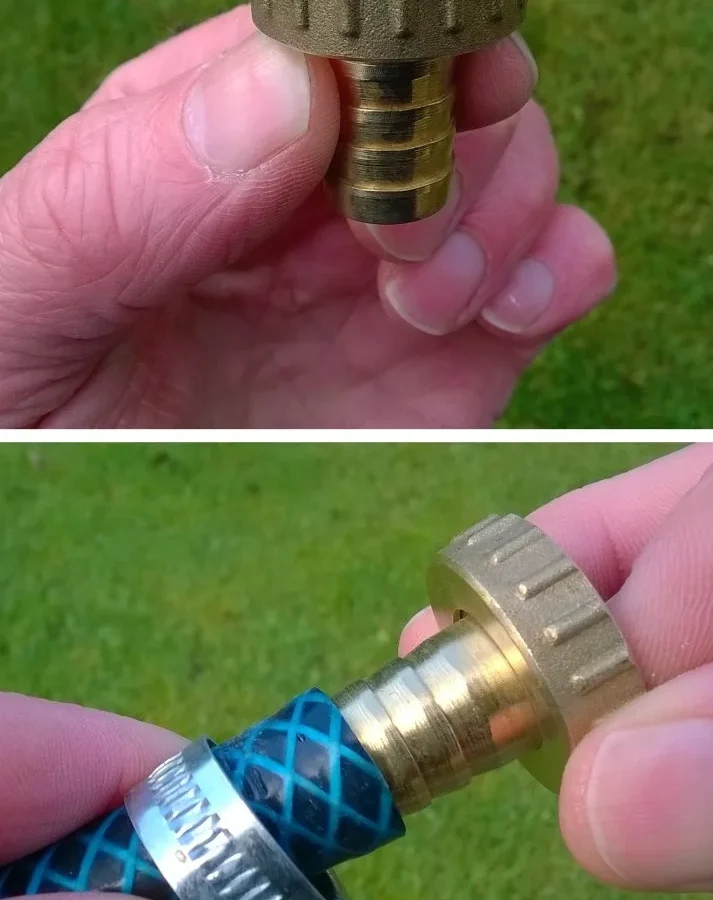
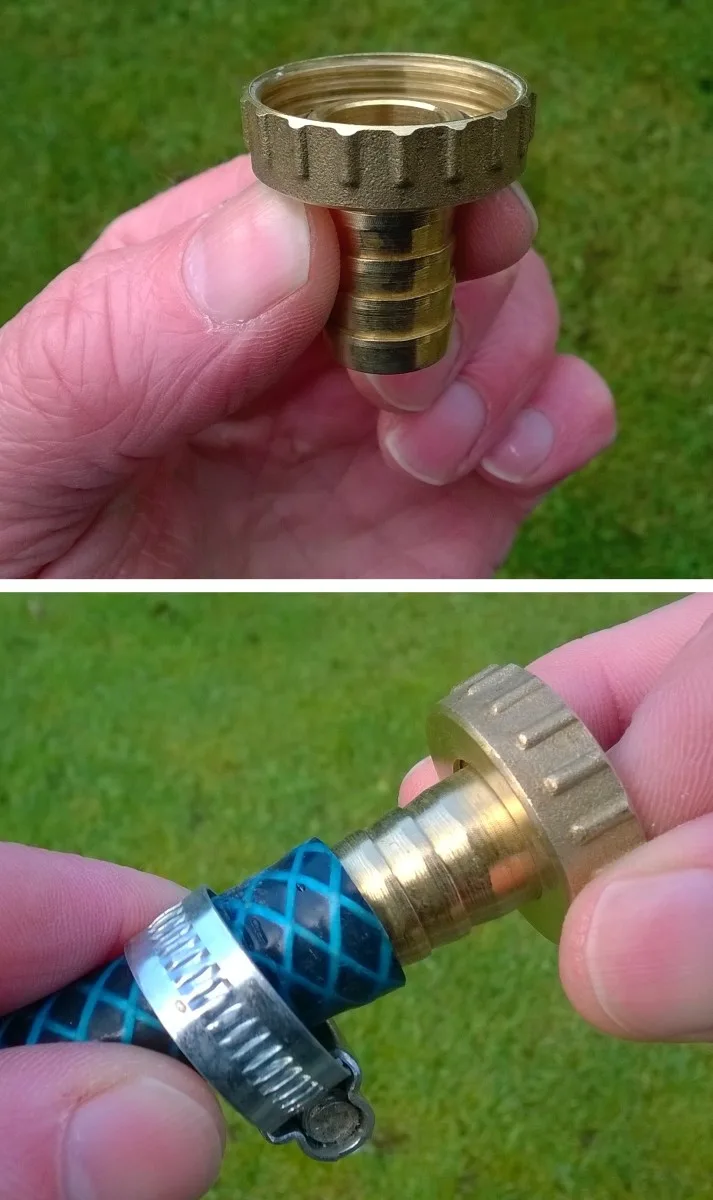
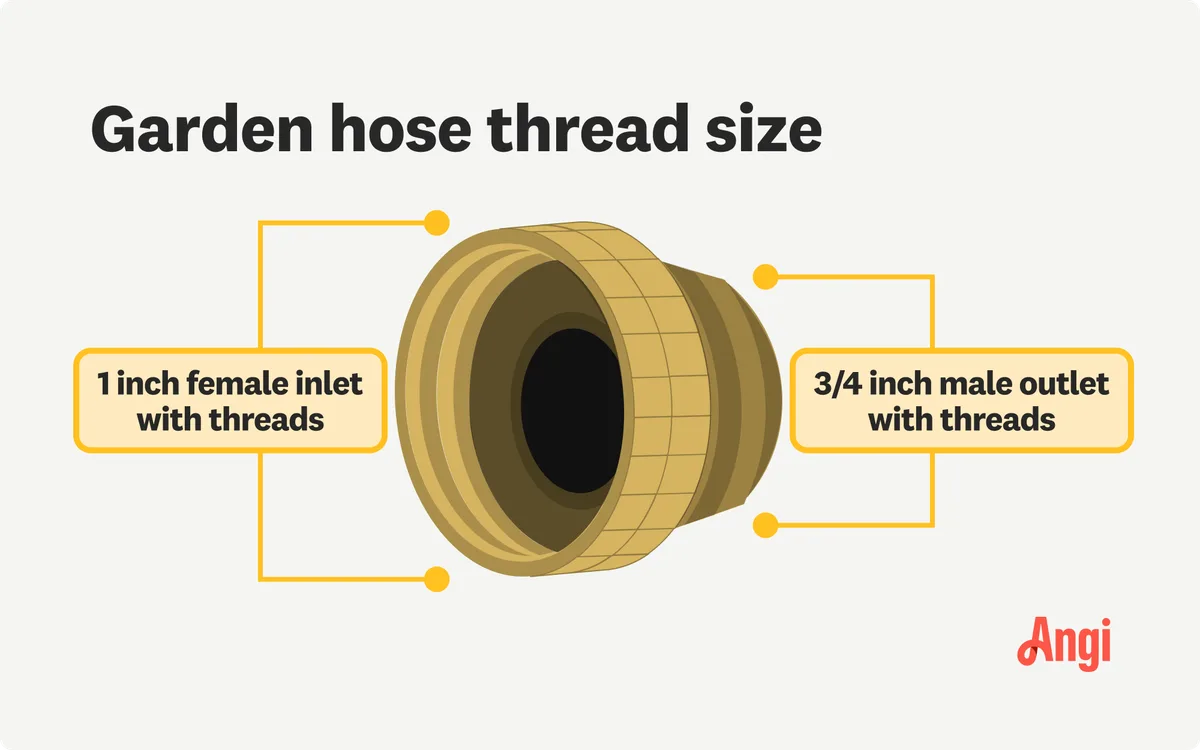
All three common hose sizes use the same 3/4 inch GHT coupling. It's a 3/4"-11.5 NH thread, standardized under ANSI/ASME B1.20.7, the governing specification for garden hose fittings in North America.
One coupling design fits a 1/2 inch, 5/8 inch, and 3/4 inch hose body. If you try to figure out your hose size by looking at the metal end fitting, you'll get the same result no matter which hose you're holding. The coupling is not a sizing indicator.
Look at the hose body itself.
Step 1 — Check for Printed or Stamped Markings on the Hose Body
Before reaching for any tool, look at the hose. Most manufacturers print or emboss the nominal size directly on the outer surface, typically within the first foot of hose near the coupling end.
Look for text like "5/8 IN", "ID: 0.625", or "Dia: 5/8". Many hoses also stamp the working pressure rating and ply count in the same area. The text is often white or yellow ink on darker hoses and can fade with UV exposure over time.
If the markings have worn off, check the original packaging or the brand's product page. If you've lost both, move to the measurement steps below. Keeping a note of your hose specs somewhere useful, like a label on your hose reel, saves this headache on future accessory purchases.
Step 2 — Measure the Inner Diameter with Calipers (The Most Accurate Method)
Digital calipers give you the only direct measurement of the inner bore. You're measuring the opening itself, which maps exactly onto the nominal size.
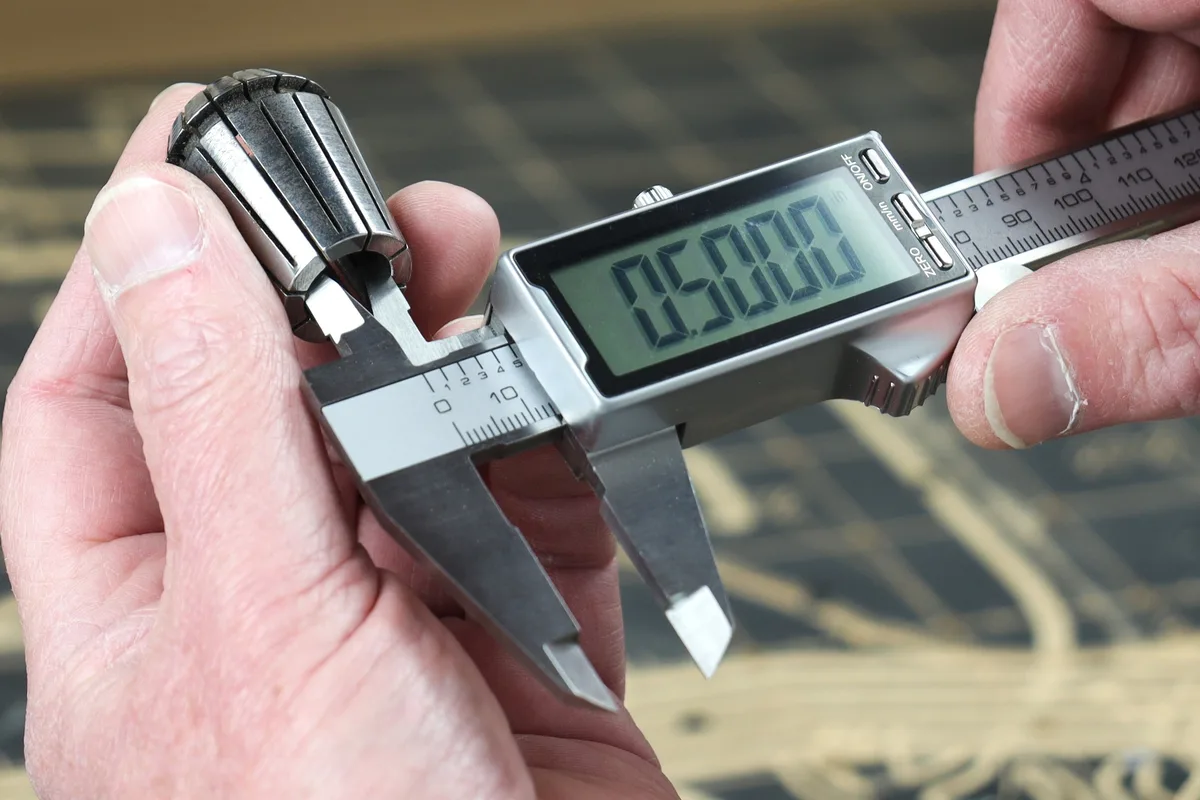
Steps:
- Zero the calipers on a flat surface.
- Switch to the inside jaws (the smaller upper jaws on most models).
- Open the jaws to fit inside the hose end opening.
- Press them gently against opposite walls of the inner bore.
- Read the measurement on the display.
What the reading means:
- 0.490" to 0.510" = 1/2 inch hose
- 0.615" to 0.635" = 5/8 inch hose
- 0.740" to 0.760" = 3/4 inch hose
Digital calipers are accurate to ±0.001 inch, which is more than enough for this task. Per NIST measurement guidance, inside-jaw calipers are the appropriate tool for bore diameter checks in light-trade and DIY contexts. A basic digital set costs under $20 at most hardware stores.
If the hose end is crimped or deformed, cut that section away first. A distorted opening gives a false reading. And if the fitting itself is damaged, replacing just the hose end is simpler than most people expect.
Step 3 — Measure the Outer Diameter and Work Backwards
If inside-jaw calipers aren't available, measuring the OD is a workable fallback. Wrap a piece of string snugly around the hose body, mark where it meets itself, then measure the string. Divide that number by 3.14 to get the OD.
Alternatively, the outer jaws of a standard caliper laid flat against the widest point of the hose work fine too.
Once you have the OD, match it against the table in the Three Numbers section above. Keep in mind that OD ranges overlap near 1.0 inch. A reading of 0.98 inches could be a thick-walled 5/8 inch rubber hose or a thin-walled 3/4 inch vinyl hose.
If the result is borderline, follow up with an inside-jaw measurement to confirm.
Step 4 — Use the Flow Rate Method If You Can't Measure Directly
The flow rate method is a last resort, but it works when you have no tools and no visible markings. Place a five-gallon bucket at the hose end and run the water at full pressure. Time how long it takes to fill.
At typical residential pressure of 40 to 60 PSI, approximate fill rates are:
- 1/2 inch hose: 9, 11 GPM (five gallons in roughly 27, 33 seconds)
- 5/8 inch hose: 15, 18 GPM (five gallons in roughly 16, 20 seconds)
- 3/4 inch hose: 20, 24 GPM (five gallons in roughly 12, 15 seconds)
Treat this as a narrowing exercise, not a precise reading. Hose length creates friction that reduces GPM regardless of ID, and home water pressure varies house to house. Use the result to identify the most likely size, then confirm with a physical measurement if you can.
What Each Common Size Actually Looks and Feels Like
Side by side, the three standard sizes feel noticeably different before you even look at a number. Weight and stiffness are often the fastest clues.
1/2 Inch Garden Hose
The 1/2 inch hose is the lightest and most flexible of the three. It's less common in general residential use and appears more often in compact gardens, balconies, or spot-watering setups where low weight matters more than flow volume. Its OD sits between 0.840 and 0.900 inches, making it visibly slimmer than a 5/8 inch hose when held side by side.
Flow tops out around 9 to 11 GPM at 60 PSI. That's workable for hand watering with a nozzle, but too slow for filling a large container or running a sprinkler zone.
5/8 Inch Garden Hose
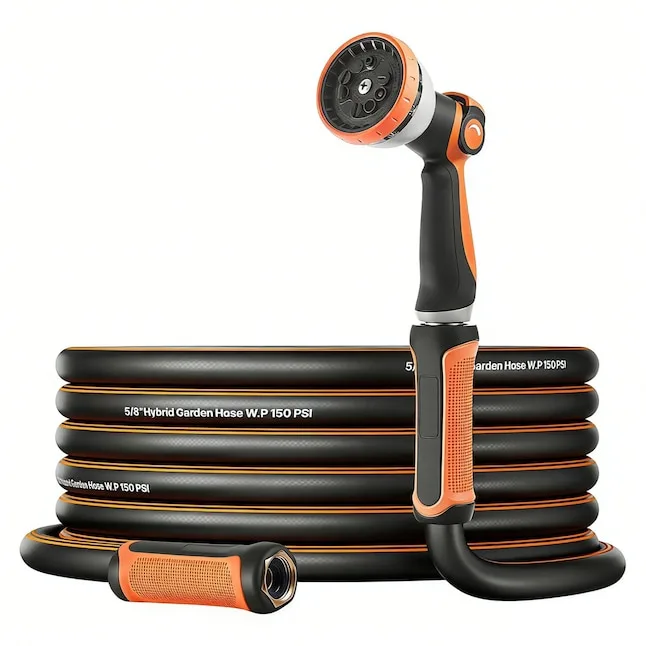
The 5/8 inch hose is what most people have. Aggregate data from manufacturer spec sheets confirms it's the most common residential size sold across North America. It's the right balance of flow, weight, and flexibility for everyday garden watering, washing down a car, and general outdoor use.
Its OD typically lands between 0.940 and 1.050 inches. It's firm enough to hold shape on a reel but flexible enough to coil without kinking under normal temperatures.
3/4 Inch Garden Hose
The 3/4 inch hose is noticeably heavier and stiffer. Most people who own one bought it for high-flow jobs: filling large tanks, running multiple zones, or handling setups that need the volume used in RV water connections. OD ranges from 1.000 to 1.150 inches, and the hose can feel almost rigid at colder temperatures.
Flow peaks around 23 GPM at 60 PSI, a meaningful step up from the 5/8 inch size.
Garden Hose Size Reference Chart: OD Ranges by Nominal Size and Material
Material type affects wall thickness, which shifts the OD even when the ID stays constant. Here's a consolidated reference across the three most common hose materials:
| Nominal Size | ID | Rubber OD | Vinyl OD | Expandable OD (pressurized) |
|---|---|---|---|---|
| 1/2 inch | 0.500" | 0.870"–0.900" | 0.840"–0.860" | ~0.850" |
| 5/8 inch | 0.625" | 1.000"–1.050" | 0.940"–0.980" | ~0.960" |
| 3/4 inch | 0.750" | 1.100"–1.150" | 1.000"–1.060" | ~1.050" |
Expandable hose values are approximate when pressurized. At rest, expandable hoses are considerably narrower and should not be measured for sizing purposes.
Why GHT Couplings Fit All Three Sizes — And What That Means for You
The GHT standard uses a 3/4"-11.5 NH thread on the coupling regardless of the hose body size behind it. This is intentional. The thread engages the spigot or nozzle on the outside.
The hose body connects internally. The coupling thread size and hose ID are two separate specs that were never meant to match.
In practice, this means a 1/2 inch hose and a 3/4 inch hose both thread onto the same outdoor faucet without an adapter. But GHT is not interchangeable with NPT (National Pipe Taper Thread), the thread standard used on indoor plumbing fixtures. The pitch and thread angle differ, so connecting a garden hose directly to a threaded plumbing fitting without an adapter won't seal correctly.
The takeaway: a standard brass GHT coupling on your hose confirms it's built to the North American garden hose standard. It tells you nothing about the inner diameter. For the actual size, you need the hose body markings or a bore measurement.
Expandable and Vinyl Hoses: Why They're Harder to Measure Accurately
Expandable hoses change diameter depending on whether they're pressurized or not. At rest, an expandable hose is much narrower than its rated ID. Measure it dry and you'll get a reading that doesn't match any standard size.
Always check the label and packaging for expandable hose sizing, or take the measurement while water is flowing through it.
Vinyl hoses have a different challenge. Their walls are thinner than rubber hoses at the same nominal ID, which pushes the OD toward the lower end of the expected range. If your vinyl hose OD reading lands near the bottom of a size range, trust the label over the measurement.
US vs. UK/EU Hoses: GHT, BSP, and Metric Sizing Are Not the Same
If you bought a hose from a non-US retailer or inherited one with unfamiliar fittings, the thread standard may not be GHT. UK and European hoses commonly use BSP (British Standard Pipe) fittings, typically 1/2 inch BSP on domestic garden taps. BSP and GHT look similar but are not interchangeable.
The thread pitches differ, so forcing them together will strip the threads.
European hoses are labeled in metric: 12mm inner diameter is roughly equivalent to 1/2 inch, 15mm to 5/8 inch, and 19mm to 3/4 inch. If you're connecting an imported hose to a US outdoor faucet, confirm the thread type before assuming it'll fit.
Mistakes People Make When Trying to Identify Their Hose Size
Most sizing errors come down to measuring the wrong thing or skipping a step.
- Measuring the OD and calling it the nominal size. A reading of 1.0 inches doesn't mean you have a 1-inch hose. That's the outer wall of a 5/8 inch or 3/4 inch hose.
- Using the coupling to determine size. All three common sizes share the same 3/4 inch GHT fitting. The coupling is not a size indicator.
- Measuring an expandable hose at rest. The inner bore collapses when unpressurized. The reading will be meaningless.
- Confusing GHT with NPT. If a standard hose fitting won't thread cleanly onto a plumbing connection, the thread standard is different, not the hose size.
- Giving up on finding the marking too early. Hose markings are often on the underside of the hose near the crimped fitting end. Rotate the hose and check in better light before assuming the marking is gone.
Now That You Know Your Size: What It Means for Fittings, Nozzles, and Adapters
Once you've confirmed your nominal size, buying compatible accessories gets straightforward. Nearly every standard nozzle, splitter, quick-connect, and garden timer sold in North America uses a 3/4 inch GHT thread. So regardless of whether your hose is 1/2, 5/8, or 3/4 inch, those accessories thread on without issue.
Where the nominal size truly matters is in hose repair kits and barbed fittings. A repair mender must match the inner diameter exactly. A 5/8 inch repair kit for a 5/8 inch hose.
Using the wrong size creates a leaking joint that no amount of clamp pressure will fix reliably.
Drip irrigation adapters also depend on ID. If you're converting a standard hose to a drip system, the inner diameter of your supply line affects emitter flow rates and pressure at the head. Confirm the size before buying a conversion kit.
Frequently Asked Questions
What size is a standard garden hose?
The standard residential garden hose in North America is 5/8 inch. It's the most common size for everyday home use. Compact or lightweight hoses are often 1/2 inch, while heavy-duty commercial options are typically 3/4 inch.
Are all garden hose fittings the same size?
Yes, in the US. All three common hose sizes (1/2, 5/8, and 3/4 inch) use the same 3/4 inch GHT coupling. That's exactly why the end fitting isn't useful for identifying inner diameter.
UK and European hoses use BSP fittings, which are a different thread standard and not directly compatible with GHT.
How do I tell if my hose is 1/2 inch or 5/8 inch?
Use digital calipers to measure the inner bore opening. A reading between 0.490 and 0.510 inches is a 1/2 inch hose. A reading between 0.615 and 0.635 inches is a 5/8 inch hose.
If the markings on the hose body are still visible near the coupling end, check those first.
Does hose size affect water pressure?
No. Water pressure at the faucet is set by your home's supply and regulator. What hose size affects is flow rate (GPM).
A larger inner diameter allows more water volume per minute at the same pressure. If your garden watering feels sluggish, a kinked line or excessive hose length is more likely the cause than the ID.
Can I connect two hoses of different nominal sizes?
Yes, with a step-up or step-down barbed adapter. Because both hoses use GHT couplings at the ends, the threads connect fine. The adapter bridges the inner diameter difference so water moves from one bore size to the other without leaking at the joint.

Similar Posts