How to Measure a Garden Hose: Length, Diameter & Fittings
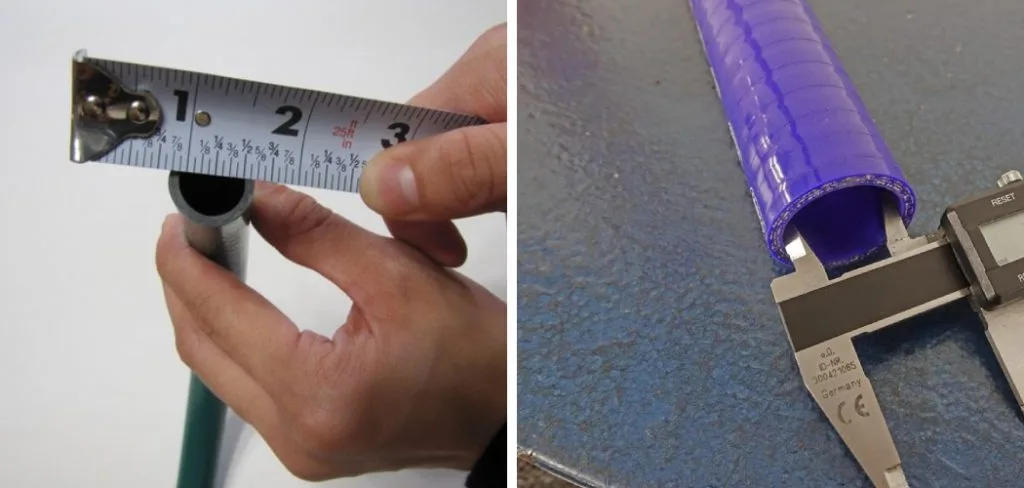
If you've ever bought a fitting and found it wouldn't thread on, the problem usually isn't the product. Knowing how do you measure a garden hose correctly means tracking three separate dimensions, not just length. Most people stop at the tape measure and call it done, which is exactly how they end up buying incompatible connectors.
The three dimensions that matter are inner diameter, outer diameter, and thread size. In the US, residential hose threads are governed by ANSI/ASME B1.20.7. That standard defines a 3/4-inch coupling at 11.5 threads per inch as the universal connection point.
Once you understand each measurement, the whole process takes under five minutes.
Quick Answer
To measure a garden hose, check three things: length, diameter, and thread size. Use a tape measure for length. Use digital calipers for inner and outer diameter.
In the US, the standard coupling is Garden Hose Thread (GHT): 3/4 inch, 11.5 TPI. The size stamped on your hose won't match your caliper reading. That's by design, not a defect.
Why Your Garden Hose Measurement Won't Match the Label
The number stamped on your hose is a nominal size. It's a category label, not a precise measurement. Put calipers on a hose marked "5/8 inch" and you won't find 5/8 inch anywhere on it.
This convention comes from older pipe systems, where stated bore sizes described manufacturing tolerances that have since shifted. Garden hose sizing inherited the same approach and never updated to use real measured dimensions.
A 5/8-inch nominal hose has an actual outer diameter somewhere between 0.84 and 1.0 inches. That range shifts with manufacturer, ply count, and material. As of 2026, no packaging standard requires brands to print the actual OD or ID on the label.
This matters most when buying fittings. If you're swapping out a worn coupling, the nominal class points you toward the right thread. Guessing at diameter without measuring can leave you with a fitting that looks right but won't seal under pressure.
The Three Measurements That Actually Matter
A garden hose has three distinct dimensions, and each one answers a different question. Knowing which one applies to your situation saves a trip back to the hardware store.
Inner Diameter (ID)
Inner diameter is the measurement across the hollow bore of the hose. It directly controls how much water flows through the line at a given pressure. A wider bore delivers more gallons per minute to your nozzle, sprinkler, or connected equipment.
For anyone setting up a drip irrigation supply line, ID is the figure that tells you whether your hose can keep up with demand. A 1/2-inch hose may fall short on flow. A 3/4-inch hose rarely does.
| Nominal Size | Typical Inner Diameter |
|---|---|
| 1/2 inch | approx. 0.44 in |
| 5/8 inch | approx. 0.62 in |
| 3/4 inch | approx. 0.75 in |
Outer Diameter (OD)
Outer diameter is the measurement across the widest external point of the hose body. You'll need this when feeding a hose through a reel housing or sizing a protective sleeve. It's also the most reliable way to identify the nominal class of a hose that's lost its label.
OD varies more than most people expect. Two hoses with the same nominal size from different manufacturers can differ in outer diameter, because wall thickness shifts the external profile even when the inner bore is identical.
Thread Size and Pitch (TPI)
Thread size is where most people get surprised. They assume it scales with hose diameter. It doesn't.
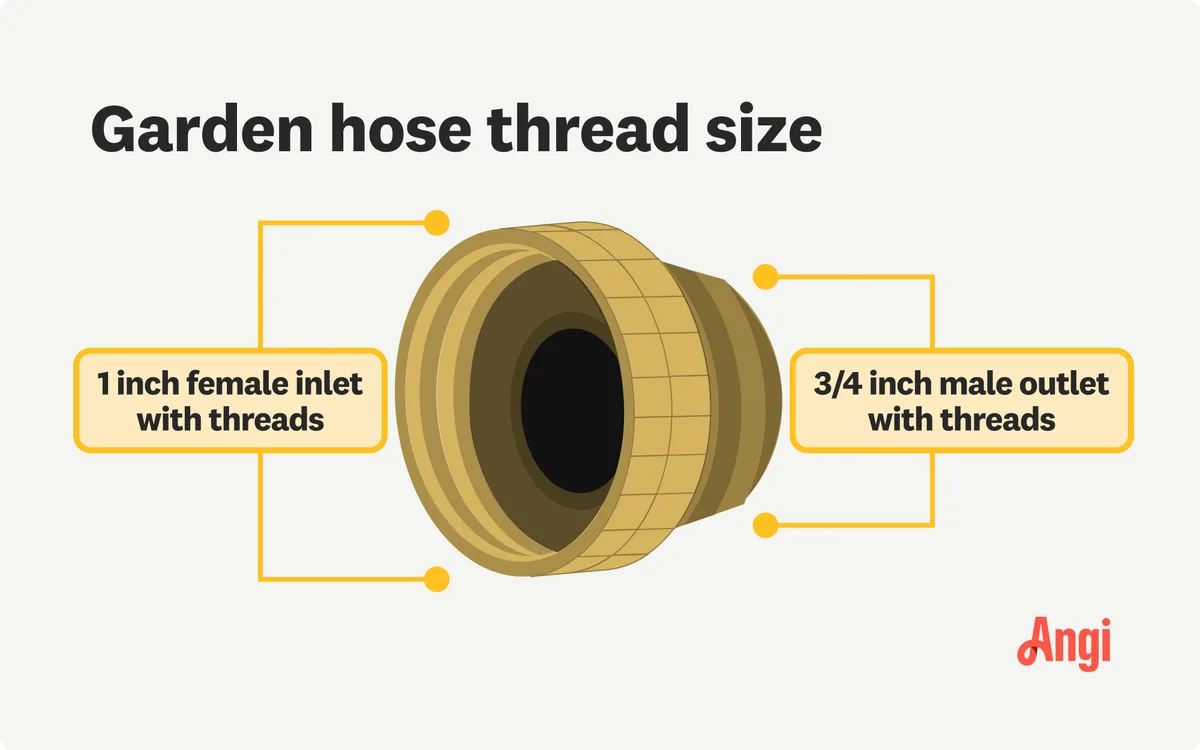
In the United States, virtually every residential garden hose uses the same coupling thread regardless of its nominal size. That thread is 3/4-inch-by-11.5 TPI, called Garden Hose Thread (GHT), defined under the ASME B1.20.7 standard. A 1/2-inch hose and a 3/4-inch hose both have the same GHT fitting at each end.
Thread size and hose diameter are independent measurements. Treating them as linked is the root cause of most fitting compatibility problems.
Tools You Need to Measure a Garden Hose Accurately
You don't need a professional toolkit. Three tools cover every measurement you'll face.
| Tool | What It Measures | Notes |
|---|---|---|
| Tape measure | Hose length in feet | Most homeowners already own one |
| Digital calipers | Inner and outer diameter | Accurate to 0.01 in; essential for diameter work |
| Thread pitch gauge | Threads per inch (TPI) | Optional; useful for confirming GHT vs. BSP |
A tape measure handles length without issue. Digital calipers are essential for diameter work, since they contact both the bore walls and the outer hose body with real precision.
A thread pitch gauge isn't something most people own. The manual alternative is to press a ruler flat against the coupling and count how many thread peaks fall within one inch. For US residential hoses, that count will almost always be 11.5 TPI, confirming GHT.
If you're connecting your hose to a pressure washer inlet, thread confirmation matters more than usual. High-pressure fittings don't tolerate partial thread engagement, and a cross-threaded coupling under working pressure can damage both fittings.
For hoses intended for RV drinking water use, also check the label for NSF/ANSI 61 certification. That certification covers potable water safety and is separate from sizing.
How to Measure Garden Hose Length
Length is the most straightforward measurement, but two details will throw off your reading if you skip them.
First, straighten the hose fully before measuring. A coiled hose has hidden length built into every curve. Lay it flat on a driveway or along a fence line for an accurate reading.
Second, measure from where the hose body begins, not from the tip of the metal coupling. Couplings are hardware, not hose. If you're buying a replacement to reach a specific garden bed, you want the usable reach.
Don't include the fittings on both ends.
Standard retail lengths are 25 ft, 50 ft, 75 ft, and 100 ft. Manufacturer specifications confirm these fall within 2 to 3 percent of the stated figure once coupling hardware is excluded. A hose that measures a few inches short isn't defective.
How to Measure Garden Hose Diameter Step by Step
Diameter is the trickiest of the three measurements. Here are both practical methods, most accurate first.
Method 1: Using Digital Calipers
- Open the outer jaws fully and position them around the widest part of the hose body.
- Close the jaws gently until they make firm contact without compressing the hose.
- Read the outer diameter from the display and note it.
- Switch to the inner jaws. Insert them into the hose opening and spread them to contact the bore walls.
- Read the inner diameter and record it separately.
- Compare both figures against a nominal size chart to confirm your hose class.
Aggregate buyer reviews consistently confirm that a consumer-grade digital caliper with 0.01-inch resolution handles garden hose measurement without issue.
One technique note: rubber hoses are compressible. Apply just enough jaw pressure to get a clean reading without deforming the hose. Vinyl hoses are stiffer and less prone to distortion during measurement.
Method 2: Using the String-Wrap Method
This method works when calipers aren't available. It gives you OD only, not ID, but that's enough to identify your nominal class in most situations.
- Take a piece of non-stretch string or dental floss.
- Wrap it once around the hose body at its widest point.
- Mark where the string completes one full loop.
- Lay it flat and measure the marked length. That figure is the circumference.
- Divide the circumference by 3.14 to get the outer diameter.
A circumference of 3.30 inches gives an OD of approximately 1.05 inches, placing that hose in the 3/4-inch nominal class.
Use non-stretch material only. Yarn and elastic return artificially short readings because they compress under tension. Twine, string, or dental floss all work reliably.
How to Measure Garden Hose Thread Size (GHT Standard Explained)
Thread size requires a different technique from diameter. You're not measuring width with calipers. You're counting threads and matching them to a known standard.
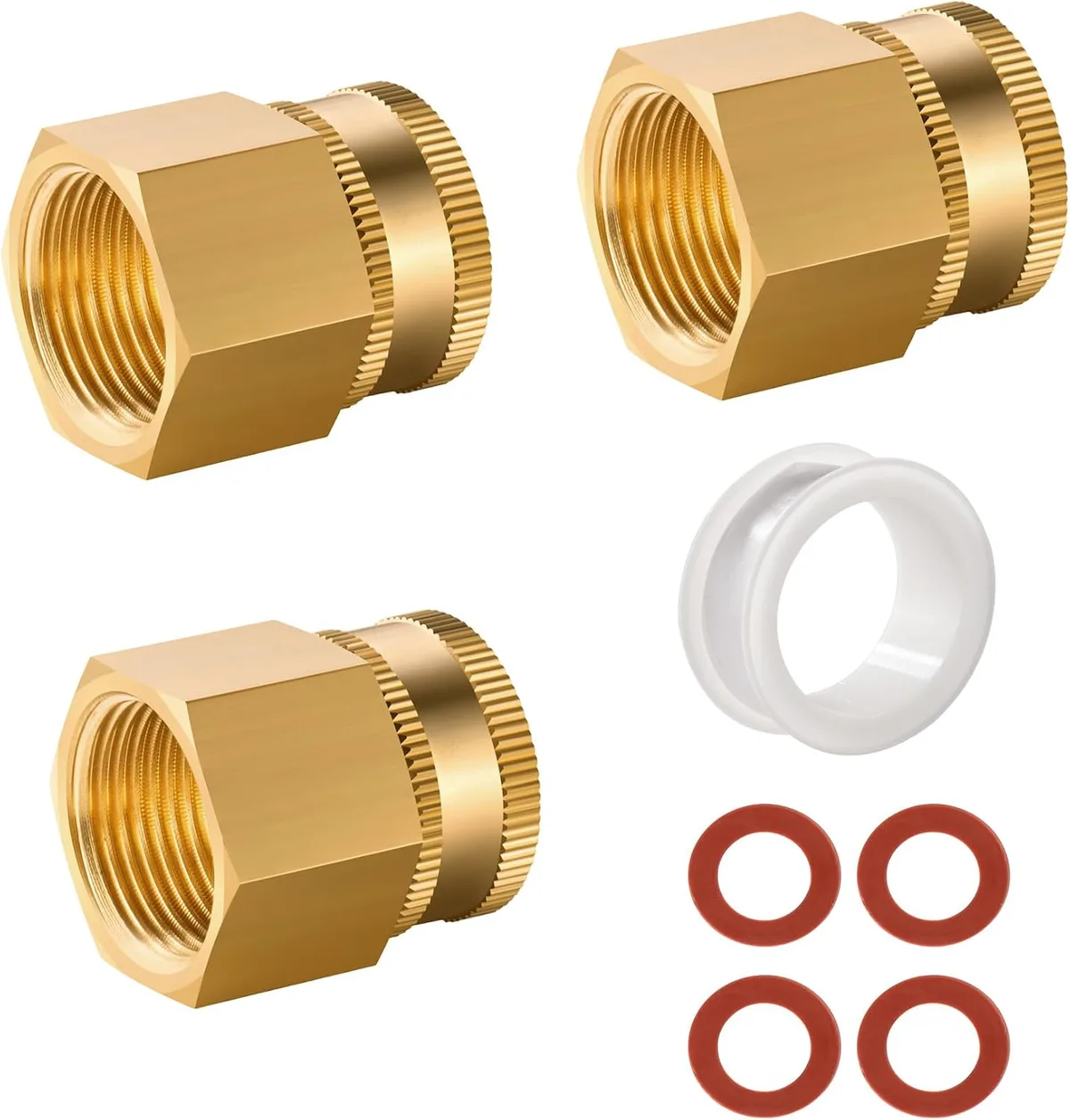
The manual counting method works for most situations:
- Press a ruler flat against the threaded section of the coupling.
- Count the thread peaks that fall within one inch.
- If you count 11.5, the fitting is standard GHT.
A thread pitch gauge speeds the process up. These small hand tools have multiple comb-shaped blades. Press each blade against the threads until one seats flush without rocking.
That blade is labeled with its TPI value.
GHT is a 3/4-inch-by-11.5 TPI parallel thread. Unlike tapered pipe threads, GHT threads don't seal against each other under compression. A rubber washer inside the female coupling creates the watertight seal.
If a correctly threaded connection still leaks, that washer is the first thing to inspect.
A quick field check: if a standard nozzle threads onto the coupling smoothly by hand with no binding, you almost certainly have GHT. If it catches immediately, verify the thread type before applying any force.
GHT vs. BSP: Why US and UK Fittings Don't Match
GHT and BSP (British Standard Pipe) look similar on the shelf but they're not interchangeable. Attempting to thread one into the other will damage both fittings.
| Feature | GHT (US Standard) | BSP (UK/EU Standard) |
|---|---|---|
| Nominal size | 3/4 inch | 1/2 in or 3/4 in |
| Thread pitch | 11.5 TPI | 14 TPI (for 1/2 in BSP) |
| Thread form | Parallel | Tapered or parallel |
| Seal method | Rubber washer | Thread taper or washer |
If a fitting from a UK or European supplier won't start threading onto a US tap, incompatible thread standards are almost certainly the reason. A GHT-to-BSP adapter is the correct fix. These are available at most hardware stores and clearly labeled on the packaging.
UK gardeners buying US-sourced hose attachments face the same problem in reverse. Checking the thread standard before ordering saves a frustrating return. Most product listings specify GHT or BSP in the compatibility section.
Garden Hose Size Chart: Nominal vs. Actual Dimensions
Use this chart to cross-check an unlabeled hose or compare a fitting spec sheet that lists actual dimensions rather than nominal sizes.
| Nominal Size | Typical OD | Typical ID | Coupling Thread |
|---|---|---|---|
| 1/2 inch | ~0.84 in | ~0.44 in | 3/4 in GHT, 11.5 TPI |
| 5/8 inch | ~0.84–1.0 in | ~0.62 in | 3/4 in GHT, 11.5 TPI |
| 3/4 inch | ~1.05 in | ~0.75 in | 3/4 in GHT, 11.5 TPI |
The coupling thread is the same across all three nominal sizes. The hose body changes. The fitting end stays the same.
This is why a 1/2-inch hose and a 3/4-inch hose accept the same nozzle.
The OD range shown for 5/8-inch hoses reflects real manufacturing variation. Rubber hoses tend toward the upper end of that range due to thicker walls. Vinyl hoses typically sit lower.
Both fall within normal production spec for the 5/8-inch class.
How to Measure Expandable and Soaker Hoses (Different Rules Apply)
Standard measuring techniques don't work reliably on expandable hoses. These hoses change diameter significantly between their contracted resting state and their fully pressurized working state.
For expandable hoses, connect to the water supply and let the hose reach full working pressure before measuring diameter. A resting-state measurement will return a bore size that's too small and point you to the wrong nominal class.
Thread size on expandable hoses is still GHT. The 3/4-inch-by-11.5 TPI coupling is standard on virtually all expandable hose brands sold in the US. Thread measurement follows the same process as any conventional hose.
Soaker hoses follow different sizing conventions. Their key spec is inner diameter, because pore output rate is engineered around bore size. For soaker hose dimensions, manufacturer documentation is more reliable than field measurement.
Calipers can give you a figure, but it only means something when cross-referenced against the original product spec sheet.
Mistakes That Lead to the Wrong Fitting Every Time
Most fitting problems trace back to a short list of repeatable errors.
Measuring the coupling instead of the hose body. The GHT coupling at the end of any US residential hose is 3/4 inch. That's the thread hardware, not your hose size. Hose diameter is measured on the body, several inches from the fitting.
Treating nominal size as a real dimension. A "5/8-inch hose" doesn't have a 5/8-inch bore. Buy a barbed repair fitting based on the stamped label alone and you'll usually end up with a loose fit or a leak.
Forcing a BSP fitting onto a GHT thread. They won't thread correctly. If a fitting won't start by hand, stop. Forced incompatible threads strip easily and require a full coupling replacement.
Measuring a coiled hose for length. Bends hide real length. Always lay the hose flat before running the tape.
Skipping the washer check. GHT connections seal on a rubber washer, not thread compression. A leaking joint with correct threads almost always has a worn, cracked, or missing washer. Replacement washers are cheap and fix the problem fast.
Frequently Asked Questions
What is the most common garden hose size?
The 5/8-inch nominal size is the most widely used for residential gardening in the US. It balances water flow and manageable weight for most general tasks. The 3/4-inch size delivers higher flow for larger areas, while the 1/2-inch size suits lighter use and shorter runs.
How do I tell if my hose is 1/2 inch or 5/8 inch?
Measure the inner diameter with digital calipers. An ID of approximately 0.44 inches indicates a 1/2-inch nominal hose. An ID of approximately 0.62 inches indicates a 5/8-inch nominal hose.
If calipers aren't available, use the string-wrap method for OD and compare against the size chart above.
Do all garden hose fittings share the same thread?
In the US, yes. Virtually all residential hose fittings use GHT: 3/4 inch, 11.5 TPI. This applies across all nominal hose sizes.
Thread compatibility only becomes an issue when mixing US fittings with UK or European products, which use the BSP standard.
Can I measure garden hose diameter with a tape measure?
No. A tape measure isn't accurate enough for diameter work. The hose body is too narrow and curved for a reliable reading.
Use digital calipers for a precise result. If calipers aren't available, the string-wrap method gives a workable OD estimate for identifying your nominal class.
Why does my hose connection leak even with the right thread size?
GHT connections seal on a rubber washer inside the female coupling, not through thread engagement. A correct thread match that still leaks almost always has a worn, cracked, or missing washer. Replacement washers are inexpensive and fix the problem quickly.

Similar Posts